After three unsuccessful attempts, a few days before the tsunami, inspired by my friend, Amit Varma, I started Green channel. It was successful in a personal way, because it was just a take on some aspects of city, the travel, the transitions, and whaddya know, a few people actually read this everyday! It's been a good ten months. I've had only one slightly angry exchange, and that was in January. I've made wonderful new friends, encountered an old friend, and even stumbled upon a writer who instantly became my favourite, though she doesn't yet know it. And one of the nicest things about being a blogger has been corresponding with people whose ideas I adore, or people I thought I'd get along with. And getting linked, oh yes, getting linked by people you respect.
This won't be a long and winding goodbye, so wait, I'm getting there.
Before last December I had written very little, so this blog helped me catch up, and proved to be an emotional crutch as well without getting into the 'dear diary' kind of writing. It also helped discover limitations, eg: Ability to write about roads and driver behavior: good. Ability to analyse merits of libertarianism over lefty ideology: bad. (So bad that I've probably got that bit wrong as well.)
But while it has been fun, I reckon it's time to say bye and get down and write for a living. Like anybody out there who can hold a pencil, I'd like to write a book someday. And travel, and sleep well, and never worry about money. So it's time I got started.
Goodbye. And see you soon.
Saturday, October 15, 2005


Friday, October 14, 2005
"Sasta hai, madam"
Overheard on TV during the Challenger Trophy final:
I'd imagine Javagal Srinath, the former Indian bowler, meant to say 'priceless'.
“It is not about the prize money. It is about winning a place in the India team, which is worthless.”
I'd imagine Javagal Srinath, the former Indian bowler, meant to say 'priceless'.
Tuesday, October 11, 2005
The oppressive Indian
Gaurav Sabnis has decided to leave IBM after Arindam Chaudhuri's Indian Institute of Planning and Management threatened to burn their Thinkpads before IBM's offices in New Delhi. Sabnis' choice was his own, and his reasons for resigning are clear: 1) To not inconvenience IBM, and 2) to stand by his principles. His comments about IIPM, an institute whose claims were first exposed by Rashmi Bansal's JAM magazine, brought him a lawsuit but no refutation of the points he made. If there was a civil way of conducting this then-potentially embarrassing business, it was through a study of facts. This route would have been less forceful than the one eventually chosen.
Bansal found herself inundated with crass messages from overnight blogs before her readers began to weigh in their support. The offensive comments ventured nowhere near fact, preferring instead to silence her through fear. The threat to burn laptops was another intimidating measure to enforce silence, and there are some victory celebrations now that Sabnis has resigned. That is a misinterpretation because Sabnis left in support of his ideas, and has found favour widely for his behavior in this matter. The alternative, to remain quiet and withdraw his opinion, would have been easier and understandable given the stakes involved. But the only way to keep speech free is to defend it, and his departure is part of that defense.
So this is an offensive to suppress truth and a dissenting voice. It is not surprising but always worrying that people choose this path. And so, further and further we slip into ignorance, not knowing the truth, not given access to facts that are our right to know because they are buried. However, the events of the last few weeks have been recorded, for posterity and easy access, as well as the aggressive manner in which the IIPM has approached argument, and the support Bansal and Sabnis have found from friends and advocates of free thought and speech. The IIPM's conduct has been despicable, for if they have not told the truth people have suffered to find their efforts and investments coming to little, and if they have not lied, their handling of this situation has been in poor taste. The internet is perhaps the last place where free speech is understood, respected and appreciated, and is a place beyond the reach of IIPM's marketing clout. If mainstream media raises the issue of speech and truth and moves on, as it must, an archive of these happenings will remain here. That these words exist at all, that this dissent is there for all to see easily, is a significant win for those who speak freely and truthfully.
Give Bansal and Sabnis all the support you can. We all need it.
A wide range of supportive opinions are to be found on India Uncut, Kitabkhana, and Desi Pundit.
Bansal found herself inundated with crass messages from overnight blogs before her readers began to weigh in their support. The offensive comments ventured nowhere near fact, preferring instead to silence her through fear. The threat to burn laptops was another intimidating measure to enforce silence, and there are some victory celebrations now that Sabnis has resigned. That is a misinterpretation because Sabnis left in support of his ideas, and has found favour widely for his behavior in this matter. The alternative, to remain quiet and withdraw his opinion, would have been easier and understandable given the stakes involved. But the only way to keep speech free is to defend it, and his departure is part of that defense.
So this is an offensive to suppress truth and a dissenting voice. It is not surprising but always worrying that people choose this path. And so, further and further we slip into ignorance, not knowing the truth, not given access to facts that are our right to know because they are buried. However, the events of the last few weeks have been recorded, for posterity and easy access, as well as the aggressive manner in which the IIPM has approached argument, and the support Bansal and Sabnis have found from friends and advocates of free thought and speech. The IIPM's conduct has been despicable, for if they have not told the truth people have suffered to find their efforts and investments coming to little, and if they have not lied, their handling of this situation has been in poor taste. The internet is perhaps the last place where free speech is understood, respected and appreciated, and is a place beyond the reach of IIPM's marketing clout. If mainstream media raises the issue of speech and truth and moves on, as it must, an archive of these happenings will remain here. That these words exist at all, that this dissent is there for all to see easily, is a significant win for those who speak freely and truthfully.
Give Bansal and Sabnis all the support you can. We all need it.
A wide range of supportive opinions are to be found on India Uncut, Kitabkhana, and Desi Pundit.
Saturday, October 08, 2005
Trippin' on books
Today I decided to visit the Asiatic library. I had seen it for many years, from the time I didn't know what libraries were about. Only upon entering it did I realise how vast it was. The ceiling was high above the tallest cabinets and the common area was so wide, I had to cover five or six subjects before I got from one end to the other. Rows of tables were surrounded by books on physics, computers, literature. There were shelves filled with encyclopedias about Islamic history, music, general topics, medicine, and other things. Impressively new books lined the entrance in glass cabinets marked 'For display only' - a way of communicating that they weren't stuffy, they had it all.
I asked a librarian about old books, very old books, say, first-person accounts of life in...
"They're over there," he said, pointing at a large doorway before I could finish. "But for members only."
The members-only area was where elderly Parsi gentlemen sat over cups of tea and discussed misfortune on leather couches. Busts stood guard occasionally, stern English figures gone decades ago. This was, however, only the common room in the members' section - a large hall which connected to the other rooms. One wall was lined with metal filing cabinets that noted the author or the topic. And this was it, apparently. There were no librarians, just filing cabinets to help you find your way around. A bit disconcerting if you think about it, especially when the secretary (of the library, as opposed to Miss Paulomi, who takes notes and files her nails all day) says to you 'we've got everything,' with an emphasis on everything. Everything? I ask, mouth slightly agape. Everything, he repeats, shutting his eyes in conclusion.
The shelves are dusty, and I find (to my delight) that books such as 'Two days in Cairo' or 'A journey into the interiors of Africa' have very few spellbound. I remove one such and it nearly falls apart, its glue having lost its stickiness. The pages are brown, with a darker brown creeping across words on some pages, and dust flies up when I flip through the book. There are shelves and more shelves full of these books. Shelves that will need a ladder, shelves that will take years to explore. I decide to join this library.
But wouldn't you know it, there's a catch. Two members have to testify for your character. Normally this would not be a problem, but someone has recently been caught walking away with pages torn from a valuable book, and the people who testified for him are now in soup. After approaching several visitors, two, the secretary and an eccentric swami, vouch for my standard of writing without knowing me. I thank them and am about to pull my hand away and leave when the swami squeezes my hand and orders me to follow him. What follows is a tour suited to a Manhattan office in speed as we climb down spiral stairs into the 'godown' - "Manuscripts, old old books, very old books, microfilm, binding room, tremendous old books here." - bounce back up and into the study area where I am introduced to researchers, and through another cavernous hall before entering the newspaper area where, I cannot help notice with some glee, stands an enormous bookshelf titled 'Travel'.
All the books I cannot have and have yet looked for, and a number of books I don't know yet that I will eventually need, are all here.
I don't know. This place, Bombay, has suddenly begun looking good again.
I asked a librarian about old books, very old books, say, first-person accounts of life in...
"They're over there," he said, pointing at a large doorway before I could finish. "But for members only."
The members-only area was where elderly Parsi gentlemen sat over cups of tea and discussed misfortune on leather couches. Busts stood guard occasionally, stern English figures gone decades ago. This was, however, only the common room in the members' section - a large hall which connected to the other rooms. One wall was lined with metal filing cabinets that noted the author or the topic. And this was it, apparently. There were no librarians, just filing cabinets to help you find your way around. A bit disconcerting if you think about it, especially when the secretary (of the library, as opposed to Miss Paulomi, who takes notes and files her nails all day) says to you 'we've got everything,' with an emphasis on everything. Everything? I ask, mouth slightly agape. Everything, he repeats, shutting his eyes in conclusion.
The shelves are dusty, and I find (to my delight) that books such as 'Two days in Cairo' or 'A journey into the interiors of Africa' have very few spellbound. I remove one such and it nearly falls apart, its glue having lost its stickiness. The pages are brown, with a darker brown creeping across words on some pages, and dust flies up when I flip through the book. There are shelves and more shelves full of these books. Shelves that will need a ladder, shelves that will take years to explore. I decide to join this library.
But wouldn't you know it, there's a catch. Two members have to testify for your character. Normally this would not be a problem, but someone has recently been caught walking away with pages torn from a valuable book, and the people who testified for him are now in soup. After approaching several visitors, two, the secretary and an eccentric swami, vouch for my standard of writing without knowing me. I thank them and am about to pull my hand away and leave when the swami squeezes my hand and orders me to follow him. What follows is a tour suited to a Manhattan office in speed as we climb down spiral stairs into the 'godown' - "Manuscripts, old old books, very old books, microfilm, binding room, tremendous old books here." - bounce back up and into the study area where I am introduced to researchers, and through another cavernous hall before entering the newspaper area where, I cannot help notice with some glee, stands an enormous bookshelf titled 'Travel'.
All the books I cannot have and have yet looked for, and a number of books I don't know yet that I will eventually need, are all here.
I don't know. This place, Bombay, has suddenly begun looking good again.
Friday, October 07, 2005
Inverted city
There is a city, a quiet city, where the streets are empty and the only sign of life is from passing cars and dogs steering cleer of them. Driving here, unlike in most cities, is a pleasure because no one tails you or honks impatiently. The space has everything to do with it. The faster you travel, the shorter the distance. The slower you travel, the longer it is, and you feel every bump beneath, too. This is also related to the fact that there is no state-run bus to clog the lanes or taxi and rickshaw (again, state-run) to swerve nonchalantly into your path. So the roads are clear. What about the people?
Well, there are few people visible. They stay out of each other's way for the space they have is a precious thing. In physical terms, your space is space - the area you occupy. Expanding it, your space is the place you carry with you to think, to react, to initiate. You can see it around the people of this city. Because of this, in a sense, the lack of a crowd highlights the individual. It seems the right way to look at people. Not a crowd, not a mob, not a teeming mass, but individuals. We are primed to take in crowds; it is a way to not be overwhelmed by so many individuals at once.
I'm not one for crowds. Well, sometimes. When they aren't being too jostly and getting in the way. But we all seem to be getting in the path of somebody without knowing it most of the time. So you could be irritated or apologetic. You could even be indifferent, but let's see how long that lasts. But with no crowds about, as in the quiet city, there is a feeling bigger than the instant obvious freedom: that of a freedom of expression. It is a blank canvas that stretches as far as you can see.
And so it is with some cities. When the clutter is removed, you see it for what it is. There's even optimism that by cleaning it up, by removing the clutter, you can make it even better this time. To see this city, the one that leaves you with hope and cheer, drive about Bombay at four in the morning.
Well, there are few people visible. They stay out of each other's way for the space they have is a precious thing. In physical terms, your space is space - the area you occupy. Expanding it, your space is the place you carry with you to think, to react, to initiate. You can see it around the people of this city. Because of this, in a sense, the lack of a crowd highlights the individual. It seems the right way to look at people. Not a crowd, not a mob, not a teeming mass, but individuals. We are primed to take in crowds; it is a way to not be overwhelmed by so many individuals at once.
I'm not one for crowds. Well, sometimes. When they aren't being too jostly and getting in the way. But we all seem to be getting in the path of somebody without knowing it most of the time. So you could be irritated or apologetic. You could even be indifferent, but let's see how long that lasts. But with no crowds about, as in the quiet city, there is a feeling bigger than the instant obvious freedom: that of a freedom of expression. It is a blank canvas that stretches as far as you can see.
And so it is with some cities. When the clutter is removed, you see it for what it is. There's even optimism that by cleaning it up, by removing the clutter, you can make it even better this time. To see this city, the one that leaves you with hope and cheer, drive about Bombay at four in the morning.
Thursday, October 06, 2005
A movie that moves you
The Transporter II.
It's not everybody's preference, but silent men who hide danger beneath a suit and practice martial arts and drive a shiny Audi past bullets without even a touch make for a really fun movie. Plus there's this evil woman in her underwear who fires machine guns. Then there's the unbelievable plot - a deadly virus, etc. - a villain who, we are made to understand very early, is an ultimate fighting machine, a car leaping off a parking high-rise onto another building, a crashed learjet, an underwater fight, a massive black killing machine who is smothered by a falling boat - oops, I'm not giving away the plot, am I? Well, lies told often enough become the truth, and so it is with unbelievable things. Everything starts to make sense. A chandelier hook a deadly weapon? Sure! A car flies upside down to detach a bomb stuck below it? It's really possible, see? It's that kind of movie. Stepping out of the theater is anti-climactic. There are no chase scenes, no gun fights, everything's just too...usual.
It's not everybody's preference, but silent men who hide danger beneath a suit and practice martial arts and drive a shiny Audi past bullets without even a touch make for a really fun movie. Plus there's this evil woman in her underwear who fires machine guns. Then there's the unbelievable plot - a deadly virus, etc. - a villain who, we are made to understand very early, is an ultimate fighting machine, a car leaping off a parking high-rise onto another building, a crashed learjet, an underwater fight, a massive black killing machine who is smothered by a falling boat - oops, I'm not giving away the plot, am I? Well, lies told often enough become the truth, and so it is with unbelievable things. Everything starts to make sense. A chandelier hook a deadly weapon? Sure! A car flies upside down to detach a bomb stuck below it? It's really possible, see? It's that kind of movie. Stepping out of the theater is anti-climactic. There are no chase scenes, no gun fights, everything's just too...usual.
Sunday, October 02, 2005
Choice of life
The choice of life is between a good one and a hard one. The two aren't necessarily different, but in this case... it's better if I explain. A good life means a comfortable life with a decent apartment, a compact Camry, maybe even a motorbike with a top speed of 240kph. It'll mean having a wine collection, something I've wanted for ages, a large library, wonderful cookbooks that are forever open in a large open kitchen that's seperated from the living room by a table. That kind of kitchen, in that kind of house, in that kind of life. You get, monseiur? It is a life of few blemishes. Those are hidden by the comforting touch of finance, that wonderful friend, that first - and last - resort. The only certainty in a world of... you know the rest. Why bother you with that? Of course this will signify a shift. A shift in homes, countries, and the most challenging move of all - in the mind. I suppose it's easy to consider those steps as an unselfish gesture, committed purely for the noble intent of caring for those strangers I've never met but who burden me with the thought of their presence - a young family. You want Yale? No problem. That ring, love? It's yours. How about a month in Turkey, then? Who's up for that?
But it doesn't all flow that way, does it? What I'm worrying for, if you haven't figured it out, is myself. The idea is to be someone, to rise and rise in every way possible. To be among people but to soar. I suppose there's always weed for that but it isn't really my scene. It makes my head spin. It's a life within reach, always tempting, always whispering seductive things to encouraging ears. The way I see it, this is how it works: there's a part, I think it's the brain, that says, "Go on, mate, leave this place, go away somewhere, make a living, be somewhere where the taxes and petrol are cheap, and you don't have to worry about books or wines." And then there's the voice of conscience, the broken voice of the hard life that says, "Money, money, money is all you ever think about and you will be happy but will you be happy knowing that you could have done something but didn't, and instead followed a family into the life of safety and security, where paunches grow behind jingling cash registers while wives stay at home? Will you resist the certainties of money and grudgingly accept the insincerity of life? It's a bitch, mate, I know, and it's also a path of ruin, but it's really worth it. Think about it. When the make a family tree, they'll have a special mention for you: The guy who did it differently. Of course you might just die anonymously in a cardboard box somewhere. And there may be no family tree."
So this is what I'm up against. What's the hard life like? Well, it's a pain, really. Bombay's hard, for instance. Everything's hard. Watching the road look different everyday is hard. The lights going out is hard. The water going out is hard. For some reason I've stopped buying into that 'but there are so many people worse off than you' argument. It's rather pointless, I think. Don't you? The point is, when I'm feeling miserable I'm not thinking about anyone else. It's my personal misery. Dammit, you'd think this is the one thing you'd have to yourself, but no, apparently this needs to be cut up into neat slices and passed around too. Everyone gets a bit.
Where was I? The good life or the hard life. The good life might be hard to take in a different way. Say I take it up, and work at it for 25 years, will I sit back and think 'my god, you oaf, just what were you thinking at 25? Why the, you sod, why the hell didn't you take the hard life?' What makes it harder is when I think of the hard life, I think of Indian women in ethnic skirts. It's like this, and this might be a madness of sorts, but hey, you don't come here to subscribe to sanity do you? Do you? Anyway, it's like this: in my mind, women in ethnic skirts are dusky, wearing bronze necklaces and bracelets from different cultures, they are 'in touch' with themselves, and because they are in touch with themselves, they look beyond money and a fancy toaster. For a few years now I've had a woman in an ethnic skirt on my shoulder where an angel or devil should be. She's my financial and spiritual adviser. Oh don't look like that. Everyone's got one. I'm sure of it.
On the other hand, she could be absolutely wrong. You know, the path with good intentions, and I know where that leads. So it's a funny thing to be caught in. Knowing your options are open but being paralysed by choice. I read somewhere that instant decisions are best not left to the democratic process. It feels that way a bit at the moment. Too many voices, too many choices. I have to make this decision soon. It feels odd to stand at a crossroad.
But it doesn't all flow that way, does it? What I'm worrying for, if you haven't figured it out, is myself. The idea is to be someone, to rise and rise in every way possible. To be among people but to soar. I suppose there's always weed for that but it isn't really my scene. It makes my head spin. It's a life within reach, always tempting, always whispering seductive things to encouraging ears. The way I see it, this is how it works: there's a part, I think it's the brain, that says, "Go on, mate, leave this place, go away somewhere, make a living, be somewhere where the taxes and petrol are cheap, and you don't have to worry about books or wines." And then there's the voice of conscience, the broken voice of the hard life that says, "Money, money, money is all you ever think about and you will be happy but will you be happy knowing that you could have done something but didn't, and instead followed a family into the life of safety and security, where paunches grow behind jingling cash registers while wives stay at home? Will you resist the certainties of money and grudgingly accept the insincerity of life? It's a bitch, mate, I know, and it's also a path of ruin, but it's really worth it. Think about it. When the make a family tree, they'll have a special mention for you: The guy who did it differently. Of course you might just die anonymously in a cardboard box somewhere. And there may be no family tree."
So this is what I'm up against. What's the hard life like? Well, it's a pain, really. Bombay's hard, for instance. Everything's hard. Watching the road look different everyday is hard. The lights going out is hard. The water going out is hard. For some reason I've stopped buying into that 'but there are so many people worse off than you' argument. It's rather pointless, I think. Don't you? The point is, when I'm feeling miserable I'm not thinking about anyone else. It's my personal misery. Dammit, you'd think this is the one thing you'd have to yourself, but no, apparently this needs to be cut up into neat slices and passed around too. Everyone gets a bit.
Where was I? The good life or the hard life. The good life might be hard to take in a different way. Say I take it up, and work at it for 25 years, will I sit back and think 'my god, you oaf, just what were you thinking at 25? Why the, you sod, why the hell didn't you take the hard life?' What makes it harder is when I think of the hard life, I think of Indian women in ethnic skirts. It's like this, and this might be a madness of sorts, but hey, you don't come here to subscribe to sanity do you? Do you? Anyway, it's like this: in my mind, women in ethnic skirts are dusky, wearing bronze necklaces and bracelets from different cultures, they are 'in touch' with themselves, and because they are in touch with themselves, they look beyond money and a fancy toaster. For a few years now I've had a woman in an ethnic skirt on my shoulder where an angel or devil should be. She's my financial and spiritual adviser. Oh don't look like that. Everyone's got one. I'm sure of it.
On the other hand, she could be absolutely wrong. You know, the path with good intentions, and I know where that leads. So it's a funny thing to be caught in. Knowing your options are open but being paralysed by choice. I read somewhere that instant decisions are best not left to the democratic process. It feels that way a bit at the moment. Too many voices, too many choices. I have to make this decision soon. It feels odd to stand at a crossroad.
Friday, September 23, 2005
Adrakchai
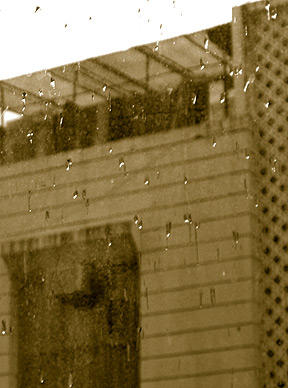
As always, it's raining outside and drops are sliding down my window lazily. There are hundreds of streaks like this, and of dried lines as well on the large glass pane. The concrete below is dark green and the building opposite is dry and wet in places. Beneath some parapets pigeons sit quietly and watch the rain. There is the noise of a busy world from far away, but here everything is nearly still. Right now, a watchman walks by dragging his bamboo stick behind him. Besides him nothing else moves. It's another quiet, contemplatively gray day in Bombay, and just right for a hot cup of adrakchai.
Wednesday, September 21, 2005
A motor
The drizzle outside was light enough only for a smile and gentle dance, but when a muted clang reverberated in the area as the lights went off, I looked up at the slowing fan, wishing for something more than electricity. It was a vague wish for an impossible dream: a motor for government, the people, and one for me.
Each recent month had brought with it hours of lost power. And there were the disasters, the burst cloud, the collapsing buildings, the confrontations between politicians who were once united, the bar girls. Each day greeted us with a sympathetic smile, and I am certain others felt this as well. It's been a weary summer. The experienced say it was always this way, that this regression is new only to you foreign-returnees. They smile and pat and say "keep going" because the city hasn't collapsed, they say, and their lives are better than they were some years ago and they now have broadband and supermarkets and modern cars, they say. It isn't comforting because "life is better now" says nothing. A smooth road, clear drains, uninterrupted power will say a lot more. It's a place to start.
I don't feel like dancing now. Perhaps tomorrow morning will be better.
Each recent month had brought with it hours of lost power. And there were the disasters, the burst cloud, the collapsing buildings, the confrontations between politicians who were once united, the bar girls. Each day greeted us with a sympathetic smile, and I am certain others felt this as well. It's been a weary summer. The experienced say it was always this way, that this regression is new only to you foreign-returnees. They smile and pat and say "keep going" because the city hasn't collapsed, they say, and their lives are better than they were some years ago and they now have broadband and supermarkets and modern cars, they say. It isn't comforting because "life is better now" says nothing. A smooth road, clear drains, uninterrupted power will say a lot more. It's a place to start.
I don't feel like dancing now. Perhaps tomorrow morning will be better.
Monday, September 19, 2005
The murderer
Indian courts in cinema have been gravely grand, their wood polished, uniforms starched, and the judge’s voice always resonant. A few days ago I wandered into a sessions court and wondered if the court scenes, like the film songs, were filmed in another country. A decrepit stairway led to the courtroom I had an interest in. It was stained red by betel juice, with paint chipping off walls that themselves were crumbling. A constable descended, his fingers intertwined with those of a slight man beside him – whose countenance was miserable. ‘But there are no handcuffs,’ I corrected myself, ‘so they could be friends.’ A few steps behind them a bald, chunky Nigerian followed, holding hands with the constables bracketing him.
The corridor on the second floor was a collection of bored accused, listless constables and smug lawyers. It was strangely chilling to realise that the accused had faith in justice. In many cases, my prejudiced eye had convicted most of them already. There was another discovery, and this brought a rush of panic: the courts branched off the corridor just as classrooms did in school; the colours were familiar, the smells were of the same musky academia. And the manner – how everything came back so suddenly, so quickly without warning! – the manner in which the judge faced the rest resembled countless colourless lessons. The real terrors that school held returned then to affect me in adulthood, and they had grown in ten years to adult proportions.
A bald lawyer with wispy red hair in Court No 4* represented a man accused of possessing 160 kilograms** of hashish. The end of his flaccid nose sloped downwards past his upper lip when he smiled, especially when the sneer followed a question to a nervous anti-narcotics officer. One such instance, when he smiled at me, I looked evasively to his feet and saw, beyond them, a large rock. In a room of straight lines, it stood out as a physical anomaly. For an instant I could see nothing, no judge, no court, but only the rock in violent hands, brought down repeatedly for dramatic effect. A nearby constable confirmed that it was indeed used to take a life. And then I noticed the other articles of evidence lying below the desk near the witness stand.
Bundles of clothes were stacked against the walls – further evidence? – and the ground was dusty. Rusty green filing cabinets stood between doors, and the windows above were opaque now but, one sensed, transparent and less foreboding years ago, when this building was new. And now, though it was known as the ‘new building’, its age was lost in wrinkles.
The courtroom could have been the corridor; whoever wished to observe the proceedings could do so, and could leave when they wished to. If they chose to stay, this is what they would have seen: every question, every answer, was followed by a long pause as the judge dictated words to a stenographer troubled by his accent; the narcotics officer clenched the railing of the witness box when the lawyer questioned his version of events; the lawyer did not know his client’s name, once correcting himself, “Mr. Pringle…Mr.Pingley…whatever his name is.”; and around me the accused sat hand in hand with the police as they waited for their version of justice. Here I felt as helpless as I have ever felt, more than death visiting because death was over in an instant while the court decided the turn lives took, and the courtroom, I realized, was a place not where the sharp distinction between guilt and innocence was found but where the lines blurred.
As the argument continued, a figure sat by me and shuffled closer. “Are you a reporter?” he asked. I said yes, to which he smiled but said nothing, sensing I was preoccupied. It struck me that the people here were not picnickers, so I asked him what he was doing here.
“I am here for murder,” he said with a warm smile. The smile did not soothe the raised hair on my neck or the tightening stomach knot. He used his hands – his free hands – descriptively as he spoke of exactly what the case was about. “This man, this judge,“ he said, “is an idiot. Look at him. He’s joking with the lawyer while we’re waiting for him.” He swept his arm across the bench where there sat a Nigerian, two men in salwar-khameez, and a slight man surrounded by three constables. He repeated this loudly, attracting attention to us momentarily, and I asked him to softly explain why the judge was an idiot.
His reasons were grudging for repeated bail applications had been rejected, and this time was no different. After he made his plea, the judge dismissed him with a wave, and his reaction was surprising. The accused turned to me, grinned through a beard and winked before he was led away, as if he had expected an outcome no different. I understood, but it was an understanding of a different kind. Between the creaky cabinets and unused clothes and open evidence, there didn't seem much space for justice.
*In my interest, the court number's identity has been protected.
**Also, the amount in kilos has been changed, though the actual amount is larger.
The corridor on the second floor was a collection of bored accused, listless constables and smug lawyers. It was strangely chilling to realise that the accused had faith in justice. In many cases, my prejudiced eye had convicted most of them already. There was another discovery, and this brought a rush of panic: the courts branched off the corridor just as classrooms did in school; the colours were familiar, the smells were of the same musky academia. And the manner – how everything came back so suddenly, so quickly without warning! – the manner in which the judge faced the rest resembled countless colourless lessons. The real terrors that school held returned then to affect me in adulthood, and they had grown in ten years to adult proportions.
A bald lawyer with wispy red hair in Court No 4* represented a man accused of possessing 160 kilograms** of hashish. The end of his flaccid nose sloped downwards past his upper lip when he smiled, especially when the sneer followed a question to a nervous anti-narcotics officer. One such instance, when he smiled at me, I looked evasively to his feet and saw, beyond them, a large rock. In a room of straight lines, it stood out as a physical anomaly. For an instant I could see nothing, no judge, no court, but only the rock in violent hands, brought down repeatedly for dramatic effect. A nearby constable confirmed that it was indeed used to take a life. And then I noticed the other articles of evidence lying below the desk near the witness stand.
Bundles of clothes were stacked against the walls – further evidence? – and the ground was dusty. Rusty green filing cabinets stood between doors, and the windows above were opaque now but, one sensed, transparent and less foreboding years ago, when this building was new. And now, though it was known as the ‘new building’, its age was lost in wrinkles.
The courtroom could have been the corridor; whoever wished to observe the proceedings could do so, and could leave when they wished to. If they chose to stay, this is what they would have seen: every question, every answer, was followed by a long pause as the judge dictated words to a stenographer troubled by his accent; the narcotics officer clenched the railing of the witness box when the lawyer questioned his version of events; the lawyer did not know his client’s name, once correcting himself, “Mr. Pringle…Mr.Pingley…whatever his name is.”; and around me the accused sat hand in hand with the police as they waited for their version of justice. Here I felt as helpless as I have ever felt, more than death visiting because death was over in an instant while the court decided the turn lives took, and the courtroom, I realized, was a place not where the sharp distinction between guilt and innocence was found but where the lines blurred.
As the argument continued, a figure sat by me and shuffled closer. “Are you a reporter?” he asked. I said yes, to which he smiled but said nothing, sensing I was preoccupied. It struck me that the people here were not picnickers, so I asked him what he was doing here.
“I am here for murder,” he said with a warm smile. The smile did not soothe the raised hair on my neck or the tightening stomach knot. He used his hands – his free hands – descriptively as he spoke of exactly what the case was about. “This man, this judge,“ he said, “is an idiot. Look at him. He’s joking with the lawyer while we’re waiting for him.” He swept his arm across the bench where there sat a Nigerian, two men in salwar-khameez, and a slight man surrounded by three constables. He repeated this loudly, attracting attention to us momentarily, and I asked him to softly explain why the judge was an idiot.
His reasons were grudging for repeated bail applications had been rejected, and this time was no different. After he made his plea, the judge dismissed him with a wave, and his reaction was surprising. The accused turned to me, grinned through a beard and winked before he was led away, as if he had expected an outcome no different. I understood, but it was an understanding of a different kind. Between the creaky cabinets and unused clothes and open evidence, there didn't seem much space for justice.
*In my interest, the court number's identity has been protected.
**Also, the amount in kilos has been changed, though the actual amount is larger.
Wednesday, September 14, 2005
The disappearing sidewalk
Past the crumbling road downstairs, behind the parked rickshaws and bicycles, is a sidewalk made entirely of gravel. It is a popular sidewalk when the road jams with cars, buses and taxis attempting ambitious maneuvers. As the option of walking along the road in the busy market becomes less risky during the day, the sidewalk is cast to one side. The gravel remains unstepped on; it feels unfit for its purpose. Under the sun it gathers dust that covers visiting shoes. The rain does it no favours either: it seeps between the gravel to provide a pleasing crunch, but also greases the grip between foot and stone. So we ignore it unconsciously, aware of a vague threat in its vicinity.
Stepping across to my favorite bookstore entails crossing this stretch of gravel. This place has the air of one where progress and construction are imminent. In truth, the gravel has been here for two years. The red bricks meant to cover it have appeared, disappeared, appeared, and recently disappeared once again. Some materials, to fill the gaps between the bricks, recently lay in white plastic sacks in a cluster outside one store. Those too are gone. Anything that is not nailed to the floor or high out of reach has been spirited away. But no one touches the gravel, though one day I believe they will discover its value for sound effects and will scoop it away. Then the road will be stolen, foot by foot, until there is no tar, and then the sand beneath will go too. Underground telecommunication pipes will be the new pavements, before they too are finally gone. Arms spread wide, we will balance precariously on them and dream of murder like Shalimar on a tightrope. Inch by inch, everything will disappear.
Stepping across to my favorite bookstore entails crossing this stretch of gravel. This place has the air of one where progress and construction are imminent. In truth, the gravel has been here for two years. The red bricks meant to cover it have appeared, disappeared, appeared, and recently disappeared once again. Some materials, to fill the gaps between the bricks, recently lay in white plastic sacks in a cluster outside one store. Those too are gone. Anything that is not nailed to the floor or high out of reach has been spirited away. But no one touches the gravel, though one day I believe they will discover its value for sound effects and will scoop it away. Then the road will be stolen, foot by foot, until there is no tar, and then the sand beneath will go too. Underground telecommunication pipes will be the new pavements, before they too are finally gone. Arms spread wide, we will balance precariously on them and dream of murder like Shalimar on a tightrope. Inch by inch, everything will disappear.
Four Septembers go by
Some time after 8:30 the phone rings. It's a friend. "There's a plane stuck in the World Trade Center." I look outside and see smoke rising in the general area of the buildings. "How could the pilot have not missed it?" he continued. "There isn't a cloud in the sky." Of the stories I've heard, this is the one I remember best because it is my own.
Here's one account, by Sukhdev Sandhu, in the London Review of Books:
Here's one account, by Sukhdev Sandhu, in the London Review of Books:
"A woman trips in the middle of the street and a dozen people all rush to help her. Strangers grasp each other by the wrist or the shoulders as they speak; they suddenly need to feel warmth, a human pulse ... And at every intersection clumps of people stand mesmerised as they gaze at the smoke fluming up in the distance. 'Where exactly was the building?' one asks. His friends aren't sure. Like many of the city's residents they've long taken the skyline for granted. Only tourists and newcomers ever look at it that closely."
Tuesday, September 13, 2005
55 words on 1st-grade love
Their first reciprocated love. They only held hands shyly, uncertainly, and on a vacant seat on the school bus. They were decent people; passion had its limits. So did relationships. She disappeared one day, without warning. In his fever he forgot multiplication tables, then numbers, and finally alphabets. But it was only a passing phase.
Michael Higgins tagged me with the 55-word story thing, so it's all his fault. Take revenge by heading over to his rather interesting site: Chocolate and Gold Coins.
Michael Higgins tagged me with the 55-word story thing, so it's all his fault. Take revenge by heading over to his rather interesting site: Chocolate and Gold Coins.
Cold turkey
The Ashes are won, Roger Federer is resting. After months of twists and dips and heroics, all that's left now is India competing with Zimbabwe. If there is art here, it will be of dubious quality. If there is destruction here, it will be unremarkable. Talents are mismatched, the experience is imbalanced. One team has no place in the sport, the other is quickly losing ground. After the Ashes, after Roger Federer, this is what we have to watch: grim faces, unsmiling underperformers, a stern Anil Kumble, an unhappy Zaheer Khan, unambitious running, unconvincing success. There are too many uns here to provide good sport.
And just two days ago Flintoff, Warne and Federer painted our tv screens red. Now there is Ganguly'x XI vs Mugabe's riff-raff. Bring those three back, even if it's only in replays.
And just two days ago Flintoff, Warne and Federer painted our tv screens red. Now there is Ganguly'x XI vs Mugabe's riff-raff. Bring those three back, even if it's only in replays.
Monday, September 12, 2005
Travels to unknown places
At airports, when there is time to kill, I sit beneath giant flipboards that announce where planes are headed and what their current status is. These black boards, with their green and red lights blinking, are magnets for the mind. The plane to Reykjavik is currently boarding at gate 12, and there is a last call at gate 3 for the Emirates to Johannesburg. Beneath it a family dressed for a safari scurry somewhere; a lady struts past, her intoxicating scent whipping those in her wake; everywhere, different nationalities and colours are rummaging and talking and heading in similar directions as they weave through the airport's processes.
Everybody is going somewhere. I am too, but I know what lies there. And so the journey loses some glitter. I know the roads and paths at the other end. The streets will be tarred, yellow dashes painted against their dark surface, there will be a traffic jam there, and it is advisable to leave a tip no less than 17.5% of the overall bill. This is what I will find there. But the other names on this board, they will take me to the Palace of Versailles where forgotten history lessons will come back, to Uluru where the stories haven't changed for a thousand years, to the Bosporus, to cave paintings at Lascaux, to the mosque in Cairo, to the world's great libraries, to the gun markets in Somalia, to where Rai comes from, to the Northern Lights, and to other places that are significant in personal symbolism if not history.
And the names keep flipping, and the signboard taunts, "This is where you could go and you could go there too, and that, my friend, is another flight missed, but wait, there is another in that direction boarding at the gate nine strides away. Go on, you know you want to." And I think, "just wait, it's a matter of time. One day you will run out of names, run out of places for me to visit. Your flips will be useless, every name visited and learnt from in this lifetime. Then you can taunt someone else enough for him to turn red, loosen his tie and say to you, 'That's it, where's my rucksack?'"
But it's just a signboard. What does it know how much it says with a single flip?
Saturday, September 10, 2005
Judging books by their cover
Books with badly designed covers make me cringe. Several times in bookshops I pick up the same book and wince, remembering that I winced the last time as well. It is, at that stage, not about the content. The design, the first hurdle, is where I stumble. A beautiful book can be tainted by bad design, and only an honest reprint can salvage it. Personally, I prefer covers that can be used as posters; often these use typography and imagery well, conveying to you in a moment what the book is about.
But design does not stop at the book jacket. How well the letters are spread out, how comfortably spaced the lines are, what typeface to use, how to signify the start of a new paragraph, how to design the title of each chapter; all these are dilemmas decent designers would mull over as one would a math problem or a swish of a paintbrush. Then there is the dilemma of generosity. How much can the designer give to the reader and the author without compromising his own beliefs and chances of an award? But this problem does not apply here. It is the first lot that are a concern at the moment.
Some publishers carpet-bomb us with words; Penguin in India is one of those culprits. One look at most of their books and you would imagine design was something those crazy foreigners with their subversive western influences did for a lark. After all, why spend time on how a book looks if people buy it for its content? That is an argument with no end. But I have empathy for the reader and the author. To be forced with a sea of words printed at an angle in blotchy ink on gritty pages is mildly unpleasant and bloody irritating. To see your manuscript mauled spectacularly and called a book only because it eventually has a fleeting resemblance to one can also be upsetting.
Inspiration cannot be a hurdle. Beside these books lie designs that transform books into even more of a collector's item. The Master and Margarita is one such, as is the sepia-tinted Simon Winchester's Calcutta and Murakami's and Coetzee's books by Vintage. These designs become the author's signature. Look at John Grisham. The Pelican Brief: crackled backround, beveled typeface. The Rainmaker: same. The Street Lawyer: more of the same. (Grisham is being used for the signature aspect, not the quality of design.)
The inspiration is all there. And surely publishers know how much influence good design exerts. How to describe the longing one feels on noticing a well-designed book, regardless of the subject? It is like noticing an interesting person from a distance and being convinced that compatibility is inevitable.
"There is nothing more fit to be looked at than the outside of a book," said Thomas Love Peacock, a 19th century satirist, as quoted in this piece about the history of book covers in the Guardian. A cover can be seductive if the right hands dress it, but this is not the case at the moment. For numerous designers, designing book covers is a way of latching on to immortality. Why not tap these designers who are fed up of designing leaflets and making the client's logo smaller?
Now to the point. What initiated this post was Penguin's (the one abroad) boxed set of 70 pocketbooks. They are of remarkable design, each cover radically different from the last one. They not only appear to have not been created by the same hand, but they transcend nationality and eras. The different people credited behind each book is a reason for this: it ensures that the designer is free to concentrate on one design without worrying about a 'look' for the series. And yet they appear to be part of a set. One that made me laugh had a picture of a gruesome-looking breakfast which few would survive if they ventured toward in the first place: it was for George Orwell's In Defence of English Cooking. Zadie Smith's book was eye-catching too, as was Caligula.
There are possibilities all around, especially in a country as rich in chaos as this, where every day is a visual surprise. But unfortunately good design is not seen as an end in itself, and sometimes it is not seen at all. It needs more than skilled practicioners. It needs the people who matter to truly need it back.
Here is the Guardian essay again. It is worth a read. And below is the cover of the Caligula pocketbook, taken off Jai Arjun Singh's site.

But design does not stop at the book jacket. How well the letters are spread out, how comfortably spaced the lines are, what typeface to use, how to signify the start of a new paragraph, how to design the title of each chapter; all these are dilemmas decent designers would mull over as one would a math problem or a swish of a paintbrush. Then there is the dilemma of generosity. How much can the designer give to the reader and the author without compromising his own beliefs and chances of an award? But this problem does not apply here. It is the first lot that are a concern at the moment.
Some publishers carpet-bomb us with words; Penguin in India is one of those culprits. One look at most of their books and you would imagine design was something those crazy foreigners with their subversive western influences did for a lark. After all, why spend time on how a book looks if people buy it for its content? That is an argument with no end. But I have empathy for the reader and the author. To be forced with a sea of words printed at an angle in blotchy ink on gritty pages is mildly unpleasant and bloody irritating. To see your manuscript mauled spectacularly and called a book only because it eventually has a fleeting resemblance to one can also be upsetting.
Inspiration cannot be a hurdle. Beside these books lie designs that transform books into even more of a collector's item. The Master and Margarita is one such, as is the sepia-tinted Simon Winchester's Calcutta and Murakami's and Coetzee's books by Vintage. These designs become the author's signature. Look at John Grisham. The Pelican Brief: crackled backround, beveled typeface. The Rainmaker: same. The Street Lawyer: more of the same. (Grisham is being used for the signature aspect, not the quality of design.)
The inspiration is all there. And surely publishers know how much influence good design exerts. How to describe the longing one feels on noticing a well-designed book, regardless of the subject? It is like noticing an interesting person from a distance and being convinced that compatibility is inevitable.
"There is nothing more fit to be looked at than the outside of a book," said Thomas Love Peacock, a 19th century satirist, as quoted in this piece about the history of book covers in the Guardian. A cover can be seductive if the right hands dress it, but this is not the case at the moment. For numerous designers, designing book covers is a way of latching on to immortality. Why not tap these designers who are fed up of designing leaflets and making the client's logo smaller?
Now to the point. What initiated this post was Penguin's (the one abroad) boxed set of 70 pocketbooks. They are of remarkable design, each cover radically different from the last one. They not only appear to have not been created by the same hand, but they transcend nationality and eras. The different people credited behind each book is a reason for this: it ensures that the designer is free to concentrate on one design without worrying about a 'look' for the series. And yet they appear to be part of a set. One that made me laugh had a picture of a gruesome-looking breakfast which few would survive if they ventured toward in the first place: it was for George Orwell's In Defence of English Cooking. Zadie Smith's book was eye-catching too, as was Caligula.
There are possibilities all around, especially in a country as rich in chaos as this, where every day is a visual surprise. But unfortunately good design is not seen as an end in itself, and sometimes it is not seen at all. It needs more than skilled practicioners. It needs the people who matter to truly need it back.
Here is the Guardian essay again. It is worth a read. And below is the cover of the Caligula pocketbook, taken off Jai Arjun Singh's site.
Thursday, September 08, 2005
A clash of dreams
Dreams will clash, traveling across time zones and countries. Giant dreams of hope and misery, gathering us up on their way as waves would, rising as they reach The Oval. Can you hear the noise of these breathless wishes, whispers once, now a suffocating roar, prayers to realize unrealized dreams, to give every new hero his due, to give the last hero stamina for a final blow, to see both heroes neither bowed nor defeated?
Yesterday James Blake stepped out of the US Open, a man defeated but proud, who plays sport as it should be played: with courage, tenacity, and a smile. A man who plays the sport to his own music, as champions do. One day a slam will be his. The parallels with English cricket are there. These are parallels that run with every sport and every sportsman. Tragedy, success, jubilation, despair; all ingredients of life and its reflection in sport.
England has seen hell. Beaten at one’s own game, the losses are doubly galling for a game’s masters are expected to not lose their grip. Now they have found themselves and taken us with them as they have made one realization after another, like an adolescent superhero slowly discovering what he is capable of. These realizations are perhaps nowhere else as dramatic as they are in fantasy and sport, which are close relations. The other superhero has discovered what old age can do and how quickly it sets in, and it is now left with the grit and sheer desire that are the residue of champions’ evaporated fantasies.
And when these five days pass, what will we feel? A sense of loss is inevitable for how many series have taught us more about how games can be played, about how so much that went before was wrong only because so much here has been right? Some of us will come out rejuvenated in what increasingly looks like a new era in this game. We are here now. Where will we be when this era ends?
In five days these Ashes will be over, forever recorded only on paper and film and memories that are inevitably exaggerated. All the noise, all the sound, all gone. These five days will be beautiful; they will be all about sport, all about life. Please don't let it rain.
Yesterday James Blake stepped out of the US Open, a man defeated but proud, who plays sport as it should be played: with courage, tenacity, and a smile. A man who plays the sport to his own music, as champions do. One day a slam will be his. The parallels with English cricket are there. These are parallels that run with every sport and every sportsman. Tragedy, success, jubilation, despair; all ingredients of life and its reflection in sport.
England has seen hell. Beaten at one’s own game, the losses are doubly galling for a game’s masters are expected to not lose their grip. Now they have found themselves and taken us with them as they have made one realization after another, like an adolescent superhero slowly discovering what he is capable of. These realizations are perhaps nowhere else as dramatic as they are in fantasy and sport, which are close relations. The other superhero has discovered what old age can do and how quickly it sets in, and it is now left with the grit and sheer desire that are the residue of champions’ evaporated fantasies.
And when these five days pass, what will we feel? A sense of loss is inevitable for how many series have taught us more about how games can be played, about how so much that went before was wrong only because so much here has been right? Some of us will come out rejuvenated in what increasingly looks like a new era in this game. We are here now. Where will we be when this era ends?
In five days these Ashes will be over, forever recorded only on paper and film and memories that are inevitably exaggerated. All the noise, all the sound, all gone. These five days will be beautiful; they will be all about sport, all about life. Please don't let it rain.
Wednesday, September 07, 2005
God at ungodly times
It is 2:30 in the morning when the drums start. In a few seconds the fireworks join in, and then you hear voices, lots of voices. What happened to that High Court order about no celebrations after 10pm? Pah. You don't know where these voices are coming from, because they're coming from everywhere. And they're extremely loud and incredibly close. The pillow. Under it there might be peace. But no, there is no solace there. You count sheep with earmuffs jumping over fences but that don't work too. If you open your eyes, falling asleep will be difficult. So they stay shut while the unbearable drums keep going on, luring you to the window. They will go away. They will go away. The police will round them up and throw them into jail for the entire length of the festival. No, don't get up. The police. The police will come for them. Okay, that's it.
So you go to the window and there they are, the scums. And there's a police van behind them, driving slowly, providing protection to this lot. Not arresting them, but making sure nothing happens to these...these innocents. Delightful place, this city.
So you go to the window and there they are, the scums. And there's a police van behind them, driving slowly, providing protection to this lot. Not arresting them, but making sure nothing happens to these...these innocents. Delightful place, this city.
Monday, September 05, 2005
The Hyderabadi angle
A colleague, S Rajesh, who makes interesting observations frequently enough to have his own weekly column on Cricinfo, made an interesting observation about Sania Mirza this morning. After watching her game extensively, he noticed how she used angles to pass her opponent, how she used her wrists to create these angles, creating what we call in cricket "gaps in the field". And then he made that connection. Azharuddin is from there, as is VVS Laxman. All three are wristy and, at least in Mirza and Laxman's case, have strong forearms. It could be coincidence. But they have more in common. When they're off-target - a frequent thing - they're waaaaay off-target. But when their game and mind are in harmony, they can be breathtaking.
I wonder if Mirza then, like the other two, is a 'touch' player; a player whose game is based more on instinct and harmony. Like David Gower as well. Which is why, when they're out of sorts, they don't merely look terrible, they appear to have walked into the wrong sport.
I wonder if Mirza then, like the other two, is a 'touch' player; a player whose game is based more on instinct and harmony. Like David Gower as well. Which is why, when they're out of sorts, they don't merely look terrible, they appear to have walked into the wrong sport.
Sunday, September 04, 2005
Sehwag's feet and Benaud's brain
Sehwag's feet have never moved. So everytime he's bowled, why, why, why do commentators have to say, "No foot movement there," as if that is the reason for his failure? I shudder to imagine these men, the commentators, giving out advice to youngsters eager to make it big. They would do well to heed Richie Benaud, who said something simple about commentary: He doesn't speak unless he has something to add to the picture.
Benaud's admirable trait is rare, though. As cricket writers - actually, I'll stick to myself for this example - as a cricket writer, there are so many voices out there expressing so many opinions that you need to say something different, radically different, to be heard. And so you say it. And then there are so many voices after yours that your opinion is often lost in the melee. What's infinitely tougher is to keep thoughts to myself.
Benaud's admirable trait is rare, though. As cricket writers - actually, I'll stick to myself for this example - as a cricket writer, there are so many voices out there expressing so many opinions that you need to say something different, radically different, to be heard. And so you say it. And then there are so many voices after yours that your opinion is often lost in the melee. What's infinitely tougher is to keep thoughts to myself.
Subscribe to:
Posts (Atom)