Let's start with how you began.
I used to be very shy, very enclosed, but I had a passion for certain things, like cricket and patang-baazi. I used to go deep into it. I used to hate schools because we used to go at 6 in the morning and return at 6 in the evening. I wanted to grow and get away from school. I used to dream ki kab aayega woh din jab school khatam ho jayega. That's why I tried my hand at cricket, and took it seriously. But I realised that it needed more than just passion. It needs more support, a support system. I decided early not to waste time. And then suddenly there was this art movement where Naseer and Om came on screen - they were just mesmerizing. They just gave you a different definition of entertainment and performance. They instigated me to want to learn the craft. Then somebody told me about the National School of Drama (NSD).
You mentioned in an interview that NSD wasn't all that you hoped it would be. What were you expecting from it?
I was naive. I expected that I would go to NSD and they would teach me to act. But now I know that in any creative institution, there's no guarantee that they will teach you creativity. It's up to you to pick up things. It's a journey. I had so many questions for my teachers, but many didn't have any answers. Am I an actor? Am I decent? Is it possible for me to become an actor? There were so many doubts. Then I learnt that you can't learn from an institute. An institute can provide you with atmosphere and can give you facilities and expose you to new things. There could be one or two teachers with whom you can interact. But acting is an art that you have to do to learn. You can't think about it. It's like swimming. You have to get into water to learn it. But I was fortunate to get into NSD. It changed my perceptions about myself. Suddenly I had to see things objectively, from a distance.
Because acting requires an actor to let go of himself, does it also reveal him to himself?
Yes. There was a basic need for me to let go of myself. Acting requires that. It also cures you somewhere or the other. You try to deal with yourself. I have a hidden relationship with adulation. I want to be cured of the desire for appreciation. It's like a disease. It's not a good thing to get constant admiration. You should be able to live without it. I realise it's a need, but I'm not very easy with it.
Wasn't The Warrior something that lingered for a while?
Definitely. You're always on the lookout for an experience that will grab you. But those kinds of experiences don't happen all the time. There are very few stories, very few units, very few directors who can engulf you. And The Warrior was that kind of film. I was doing television at the time, and it was the first time I had done a film in one go. That film was shot in extreme conditions, and at the beginning I thought I wouldn't be able to take it. I had to wear a wig in 49 degree temperature, and there was the armor and the horses. But then the body adapted to it and it became an experience. And the kind of approach Asif Kapadia [the director] had was fascinating for me. I was bored to death with the kind of work Indian cinema demands. You have to say each and every thing. You can't live in the character's moment. And here was a director who said, 'Don't suggest what you're feeling, just be there. Don't indicate, don't demonstrate.' In our films we have to demonstrate what we feel. Even if the actor doesn't feel it but demonstrates it magically, they love it. I was looking for something deep, a connect, where I didn't have to show.
Is demonstration done because the audience demands it, or is it because of a preconceived notion of what the audience demands?
The demonstration is in the director's subconscious, because he depends on it - he doesn't explore cinematic language. Our industry has not evolved that much. We want to communicate through what an actor says, not through the camera or the language of cinema. There are very few directors who do this. Like Sriram Raghavan. He really knows the language. Most of us just put the camera somewhere and ask the actor to say what the story wants to say. But that's not cinema. I think they don't see the need to do otherwise. They accentuate everything: 'Actor ki aankon mein aasoon hoga, woh ro raha hoga, music bhi ro raha hoga, saamne waala bhi ro raha hoga.’ They hammer it in.
How is Vishal Bhardwaj's way of working?
Vishal is very good with scripts. He's good with atmosphere. He's a very fast learner and the kind of cinema he likes helps him grow. I've read other scripts with Vishal and they didn't have magic, but suddenly he comes out with a script that has this magic. Like Omkara's script. It's fantastic. The atmosphere was so entertaining, so real, so thick, that I don't think anybody else could have done that. He is special. He has a special knack about characters, and can tell a story in a different way, but he doesn't experiment with the language of cinema. He does it at the script level. He wants the cameraman to be his equal partner. So for him the cameraman is a very important person.
Is it difficult to make his kind of movies? They're not exactly Yashraj movies.
It's a new kind of cinema, a new kind of story, and has a different kind of impact. Yashraj films are made to please you, and make you feel comfortable about yourself and your values. That is where Yashraj's cinema dwells. It doesn't go beyond that and challenge the audience's sensibilities. But Vishal, I think, doesn't find that interesting enough. He goes beyond that. His heros don't have to be chocolatey, or good-looking. In Vishal's films it is his inner world that is fascinating.
2003 was an interesting one for you in terms of names. The Internet movie database has listed you as Irfan Khan, Irrfan, and then Irfaan with two 'A's. Were the name changes for reasons of luck?
It's a mistake. It was never Irfaan. I added an 'r', definitely, but not for numerological reasons. It was about phonetics. But incidentally Irrfan added up to a good number, and I'm not proud of it. Sometimes I don't like myself for doing this. I was trying to fool myself. My mother said it sounded correct, the phonetics were right.
Does someone like Om Puri, who seems to have found that middle path between performance and income, give you hope?
One thing I've realised is that no two actors can have similar track records. Every actor has his own journey. Om Puri was doing all kinds of cinema, every kind of film, small roles, guest appearances, B-grade roles, A-grade roles, and suddenly he started getting films abroad. People do get opportunities. I don't think you can base your journey on somebody else's. I think life will give me opportunities, but I have to keep working on my own convictions.
What are those convictions?
To work in projects that engage me, to become commercially successful in cinema. I don't want to just be an actor who's saleable in Indian cinema, but want to work anywhere.
People often talk of an actor's bankability, about whether he delivers hits or flops. But isn't an actor just one component of the project?
I think the actor gets undue importance. I think that's because storytelling is done through the actor. It's the director who should get that importance. He's the one telling you the story, he 's the one casting you. In Hindi cinema, actors are treated like magicians. People just write lines and expect actors to do magic. That's why it happens. Ek simple line hogi, Amitabh Bachchan will say it, people will be mesmerized. It's not an actor's medium, but if a film is successful the actor is given credit, and if it fails, the actor has to face the blame.
So an actor's just one part of the entire movie.
Yes, he's just one person. But our commercial cinema depends on personality. It doesn't have to deal with the truth of the situation. They depend on the charisma of an actor.
But then isn't a personality, in this sense, also a form of stereotyping?
Well, people do want to see them again and again because we don't have a culture of seeing different stories and characters. We don't have a culture of realism. We had a history of Parsi theatre. We had melodrama and jugglery. In all our folk forms there's no tradition of acting, although the Natya shastra has a method which people haven't practiced and evolved.
Would you consider yourself an instinctive actor?
I want to be. But at NSD I tried working out everything. I used to even track the thought process of the character. I never felt easy with it, I never enjoyed it. It was like a crutch. You couldn't leave yourself open to spontaneous things. But I used that crutch to not fail. It felt wrong, though. I felt I should just respond to things. Slowly, I began to rely on instinct. Now I don't want to work on something too much - I want to know the broad graph of the character. It has to happen that way, otherwise there's no magic, there's no fun. That's why people say actors should be brave. The actor must have courage to let go of himself, and to rely on his instinct. But that comes late. It is something you have to keep reminding yourself about and keep on practicing.
But you need a lot more than good acting to make it here.
Yeah, acting doesn't count, actually. But I knew that I didn't have anything else to fall back on. I had to rely on it to be successful. And I had this desire to learn. But here, you don't need to act, you're not required to be an actor to be successful in this industry. You learn this after many years. You have to become comfortable in front of the camera, you do whatever they want you to do, and you do it being yourself - you don't have to put on a character. You don't have to understand any other person. If the dialogue assistant asks you to say a line, you have to say, 'Okay, I'll say this line.' It really works.
Sounds just like television serials, especially the jaded parts.
I don't want to name people, but I've worked with certain actors who've done cinema for 15-16 years. I see their fatigue. As soon as they arrive on set they want to know the pack up time. Kab kar rahe hain pack up? Kab ho raha hai pack up? You know, I don't ever want to be in that situation.
What do you fear?
There's definitely a fear that you might become a machine who just... Look, it's a market. You're a commodity. There's a fear that you might start using your own image. You have to check yourself. The fear's there, but I'm sure I won't do that. I... I wouldn't be able to take the pain.
Is there someone who gives you feedback? Your wife?
My wife has been a very strong critic of my work. She never used to like my work at NSD. We used to have fights because I wanted her to tell me how my performances were, and she would avoid telling me. She used to find diplomatic ways of telling me this, and I would see through her. I'd confront her, 'Why aren't you telling me that I'm bad?' and she'd say, 'I'm not saying that.' I was in a hurry to become a good actor. I didn't realise that it takes time. You learn this craft through age. Your experiences are what you put in. If you don't have experience, what will you put in your work? And then there's the craft of using your experience. You might have a lot of experience, but how do you use it? How do you make it a performance?
You say you were in a hurry, and you've said before that you were ambitious then. Did you find the need to pull back and see where you were headed?
The journey would have been easier if I had done that. But I was adamant and too impatient. Things changed slowly. I don't enjoy television very much, but it gave me a chance to practice. Sometimes when you are bored with things, when there's a lot of preparation, you get stuck. But then suddenly you start flowing. You do a certain thing so many times that you don't think about it; it becomes second nature. That's what television did. I was so bored of acting that I didn't care. I then realised that since I had let go, I had begun to enjoy it.
Did you look for work actively when you graduated in 1989?
I tried. But whenever I met people and tried telling them that I'm an actor, I never got work from them because I couldn't impress them, or make an impression on them. I used to feel humiliated while talking to them. So I abandoned the exercise after a point.
How were you humiliated?
You call somebody, and expect him to talk to you properly, but people are busy. Then you have to introduce yourself. 'I'm Irrfan.' 'Who Irrfan, kaun Irrfan?' 'Main actor hoon NSD se.' 'Haan, toh?' It just puts you off, and you don't want to go through that humiliation again and again. I did try.
Was money an aim?
Definitely. I wanted to earn money. I wanted to live life with a lot of money. And I knew that if my work was noticed, I would get money. Even today I know that if a film works, I will be a viable actor and will be able to charge more, and I will have more choices. Money gives you freedom.
How do you prepare for you roles?
There are many ways. It depends on the role. For some roles, you need to know the physicality of the character. If he's a taxi driver, I should know how to drive a taxi. I should prepare the physicality of it. Then, you try and understand his emotional construction. What he wants, what his drive is, why he's there in the story. You should think of all those things. Think, what if he takes a different stance, what will it do to the story? I go according to the story, how he is placed in it, and what he's doing to it. But that's if I respect the story. If I don't, I try to entertain you. Like Gunnah. I knew it was for front benchers, so I tried to amuse them. With Maqbool, I know I don't have to supersede the story. I have to give myself in and be invisible, so that I don't distract the story, so that I carry the story. So you understand it bit by bit, scene by scene, and understand the bigger picture, the story, what the director's trying to do with it. Also, I learnt after NSD that when you read a script for the first time, it does something to you. You shouldn't lose that something. We used to kill that, the first instinct, by preparing and analysing it. Sometimes there are things you shouldn't talk about. If you start talking about those things you lose them. There are some experiences you can't formulate into language. If you do formulate them, they become something else. Language has its limitations because it can't match the experience. When you read something, it's not the real deal, it's a manipulated impression.
Let's say you were in love with someone. How would you deal with a role like that?
Over-analysing it would definitely kill it. Maqbool was a love story for me. I never thought it was like Macbeth. And there are perceptions of love that I've got from cinema only, perceptions which are not real. The concept of love, of loving somebody, of dying for somebody - I've never experienced that kind of love except through cinema. So there is an old picture of love that I have inside me, and what do I do with that? So I live that in a story, and I love it! I know it's not real, that it's romantic, that it's false, but there's some attraction in it. It's a perfect picture of love.
Would you opt to use that perfect picture of love instead of what love could really be?
Yeah, I would use that. What love could actually be depends on what you experience. I don't know what real love is. What we call love is an attraction between two people. But pictures, shairis, literature, have given it a different perception altogether. And you do enjoy it. Sometimes, when you want to cry, you listen to songs from the 60s and the 70s. What do you do with that world? I don't want to destroy it with my rational feelings. I want to believe in it. And I have experienced certain moments like those, in Maqbool, during Tabu's death. Although they didn't keep the shots, those takes were an experience for me. I have never cried with such feeling. These are experiences you relish. That's why you act.
Is there a danger that your worlds might overlap?
We don't have that kind of cinema. We don't give an actor that kind of a world to immerse himself in. We're almost detached. We don't want an actor to put himself in the line of fire, we just want him to perform. If we have those kind of films people will be affected. I heard Saif Ali Khan say after Omkara, 'When will I be over and done with this role?' Sometimes it does affect you. That's why after The Warrior I detested the idea of taking up Haasil. The Warrior's world was completely different. It was about fighting with his own past, it was a mesmerizing journey. And here, in Haasil, is Ranvijay Singh, a person who's trying to manipulate things, and there are so many negative thoughts. I didn't want to think like that, I didn't want to deal with that person. So it took me quite a while to get over The Warrior. I turned down every offer that came to me after it, saying that I wasn't ready for it. And it was good in a way because I wanted to elongate the experience.
You've said that when someone gives you too many instructions you tend to feel trapped. Would you prefer the director give you a sketch of the character, or a detailed account of the character's life?
Every director has his own way. There are some who want you to think the way they are thinking about a character. But I find that it's a trap. You should have the freedom to explore it on your own. If an action makes a difference to the story, then you definitely have to follow the director because he's trying to get an effect out of it. I would prefer a director tell me, 'I want this kind of effect from you'. But then sometimes a director gives you general instructions. 'Yaar, thoda zyaada ghussa chahiye.' That puts you off. What does 'zyaada ghussa' mean? It's too general. And generalities don't allow you to experience a true moment. I would prefer a director who lets me explore my own world.
In Naseeruddin Shah's movie, he really gave instructions. And I trusted him. If you trust a movie or a director, you don't mind doing what the director asks of you.
Tigmanshu Dhulia, Haasil's director, set you up with some locals at Allahabad University for a few days to understand student life and politics. What was that like?
It was really helpful for me. First we went to the Kumbh Mela, where we took atmospheric shots of the climax. Then we started shooting in Bombay. I could not get a hang of the character. Nobody knew it. Even Tigmanshu thought everything was fine. But I kept wondering when we'd go to Allahabad, because the way they think about violence there is so poetic, and it's completely different. I could only say my lines with such ease because I saw these people, I met them, I could see their world, how they reacted to violence, how they talked about it, what bravery was for them.
And Tigmanshu has this thing about being entertaining. I like him because he has this talent for making realistic things entertaining.
How do you perceive realistic acting?
First and foremost, the film and the actor have to grab the audience's attention. I could see Tigmanshu's approach, and I loved it. I find realistic actors boring sometimes. They equate doing mundane things with realistic acting. People become casual, believing that what they are doing is real. But that's boring. What you do in theatre and cinema is a very calculated, manipulative, thing. It has to have some meaning and has to add to the situation.
In Haasil, you complain to Jimmy Shergil: "What should I do? God has made my eyes this way." Was it reflective of the fact that in real life your eyes had acquired a reputation and life of their own?
They have acquired one, and I still don't understand why. People do react to my eyes like that, they say that they're special, that I act through my eyes. I haven't done anything like that. Maybe it's the physicality, or maybe there's some transparency in my eyes. I haven't yet understood. They look intimidating sometimes. They became a limitation before I got Haasil. I heard friends who were making a film discuss, 'Yaar, what will we do about his eyes? He doesn't look normal. He can't be a normal man'. Initially people used to say ki charsi hai, when I had no such habit. Sometimes I'd do it, but it wasn't a habit. I can't take charas much, I can't function. When Tigmanshu wrote the line, I realised that he found my eyes intimidating too. And you can feel the smile on my face when I say the lines.
How did Salaam Bombay! happen?
I was doing a production in NSD, Mira was casting, she came to see the play, and she called me. I was supposed to have a significant role. Finally they decided to chop off the role because I didn't look like I was one of the street kids, I looked older than them. That was the first jolt I got. I cried and cried and cried. Then Mira Nair called me for another, smaller, role - that of the letter writer.
How did Ashoke Ganguli in The Namesake happen?
I got a call from Mira's office, saying she wanted me to act in the film. There was no long-winded process. It was very smooth with her. When she read the book, she knew I would do this role. She didn't have other options for it. That was good because I'm not very good with auditions. I'm not very good when I know I'm being tested. I'm very bad at exams. I hate competition. [Laughs] I don't perform well in those circumstances. I'm fragile. So I do enjoy it when somebody says, 'You are doing this film.' I come with all my energy and spirit.
How did you research and approach the life of Ashoke Ganguli?
You had asked me if the experience consumes you. This film consumed me. It became an experience I almost wanted to get away from because it dealt with old age. And when you are about to touch old age, you want to push it away. But here I had to experience it. Here's this guy who's almost invisible, he doesn't have any presence. That was the most challenging thing for me to do - to do a role in a manner that you don't catch attention. Being that docile, that unobtrusive, really took some effort. And to go through the experience of old age was painful. It was taxing to experience it. For that I called my family to New York and spent all my time serving them. It helped me understand how Ashoke Ganguli dealt with his family and his own trauma through his family.
When you experienced old age, did it occur to you that you didn't want to be there?
I was never serious about old age and never thought it would come to me. I never realised that your body starts telling you that it can't move swiftly. That's the most painful part about old age. Although there are some good things about old age - you understand life better, you deal with yourself a little better - the physical aspect is a painful thing.
People often confuse a good physique and presence with good acting.
We don't have an understanding of characters in cinema. We see people who are larger than life, who do things that audiences would like to emulate. Someone who's not real, who's fantastic.
In that sense, are we looking at actors to fulfill the kind of stereotypes we've got?
Yeah, we do want stereotypes. Our audiences do want something that's not real, that has a dreamy quality about it, which has nothing to do with mundane life. Also, people confuse good acting with roles. If a person has a good role, they say he's done well. But it's the way the role was written that does the magic. If the character does something, they think it's the actor who's done it. It's actually the writer who makes the character do certain things.
A layperson can't tell where the role ends and where acting begins. But can other actors?
Yeah, one can make out when an actor's trying to supersede the story, or when he has underperformed, or how much scope the role had. Definitely.
Is knowledge of film history important for actors, to know where they come from?
No, although if you have information, somewhere it all adds up. But I don't think it's necessary. It's your understanding of the situation and human beings that counts. Otherwise I don't think an actor has to be intelligent or socially aware. Sometimes a dumb actor is better than an intelligent one because intelligence can be a hurdle in believing in an incredible situation.
I watched Rog over the weekend. It was a strange film. Not in a good way.
Yeah, it was supposed to be strange and mystical in a positive sense, but... [giggles].
On what basis do you select your films?
That was because of Pooja [Bhatt]. She tries a different kind of cinema. And when I heard the idea, it was okay, you know. I thought if it was done well... But the scripting was not proper. It was dated. Whatever element came in was because of Mahesh Bhatt. I kept telling him we couldn't shoot a whodunit in today's times. He kept saying it was a love story. I said where's the love? Initially it was a stone, it was dead. I got frightened when I saw the script, but Mahesh told me it would be fine.
How would you define a good role?
Something that gives you insight about a situation, about a character, about a different world, and is also engaging. The best role I have ever seen is Capote. He is manipulative, and he manipulates himself. He has his own world, his own pleasures, his own pain. Although he's doing all this he gives himself the impression that he's being faithful and doing good. In real life you don't notice many things, but when you're in the cinema, you notice them in the frame. It's about showing them something in a new way.
Are the actors you like watching the same ones you learn from?
I do. Sometimes. It's automatic. You like people who surprise you. You'd be surprised, but I like Deven Bhojani. There's a serial called Office Office. You should see how good he is. He's so entertaining, so fluent. Nowadays I don't watch DeNiro. He's done it all. Now acting doesn't mean anything to him. He's into something else. Towards the end I could see fatigue in Marlon Brando. He was tired of this pretending.
Every artist has a lifespan.
Yes, every artist does. After a point your priorities change. At a young age, you need that attention, your priorities are different. After a point age takes over and your concerns change. But then there's Anthony Quinn, there's Om Puri. Om's the same, he's so balanced! I tell him, 'Tum kya, sant ho?' He goes into any setup and it doesn't affect him! I think it's because he doesn't tax himself much, which is why it doesn't become a burden.
Is it tempting to give people that one great line, that one great scene, which they remember you by for ever?
No. I'd like to go beyond that. I don't want to be known for that one moment that I created. I do wonder when I'll get a script that will make people forget Maqbool and Haasil. It bothers me and depresses me when I think, 'Is there nothing beyond those two movies?' I want to keep doing things that become a rage. I don't want to look back at the past and say, 'Oh, those were the good times, that role back then was the one.' Now that would be a pathetic situation. I don't want to think like that. Never. Never.
This interview appeared in the Tehelka issue dated July 22, 2006.
Monday, July 24, 2006


Wednesday, July 12, 2006
The 5:54 Borivali fast
A panipuriwaala carrying a wicker basket disembarked at Mahim Junction on platform 2 moments before the 5:54 Borivali fast hurtled by a few feet away on platform 3. He worked between the two platforms, under a metal pillar that held up the roof. He made his way through the crowd and sat at his designated place. The Borivali-bound train came through. People on the edge of the platform took a step back, out of reach of travellers leaning out of the stuffed train. The force of the wind accompanying it pushed some back, and pulled some closer. A few cars behind the engine, near the center, was a compartment packed with people better dressed than those in most others, but as sweaty. Their next stop was Bandra, and before it came the Mithi Creek, which would bring a foul smell and a cool breeze. The inhabitants of compartment 528A could not have known of the incident at Bandra, and beyond it at Khar, as their car passed by little more than half the platform's length and would have, within a couple of seconds, traversed the rest too. They would have barely noticed faces on the platform at that speed, and among them the panipuriwaala, when there was a white flash.
The explosion blew the roof off the train as well as platform 3, and killed the panipuriwaala instantly. The compartment's left side was reduced to serated metal tatters, and at that instant a mangled door flew into the crowd. It rained glass, shingle, puris, spectacle frames, clothes, shoes, toes, legs, fingers, hands, bodies, heads. The green metal walls that seperated the doorways from the seating area tore away from the ceiling and bent backward in an instant. Chair frames, harder than flesh and bone, had their legs broken, and the chairs themselves leaned back, facing the source of their trouble. The compartment's right side was intact but blown outward, like an inflated tetrapak, and there was carnage there too. And the confusion. The train had not yet stopped, and with one side of the car destroyed, commuters jumped off in the opposite direction, on to the track by platform 4, where a train ploughed into them. 15 alone went this way, bodypickers said.
The intern from KEM hospital was on his motorbike with a friend in Matunga, heading toward Bandra, when he heard an explosion at 6:30. It was at the station, three kilometers away. He raced back to the hospital and wore his scrubs, and took his first breather at 3am the next morning, when he walked alone in the courtyard and stared past the fence at nothing in particular and then sat on a green stretcher with a touch of red on top. Outside the hospital were chalkboards with names of the admitted and the dead. A man speaking on a phone said, "We've looked everywhere." The woman beside him was shattered. By the hospital entrance a woman howled and buried her face in her husband's lap, and family gathered around them in vain. His eyes had glazed and he looked straight ahead without expression while patting her robotically. Behind his wife was another woman, sniffling. People stood in groups, saying nothing, too tired to break silences. They either waited, or they knew. Every now and then people would stride in purposefully, their calm countenances constructed solely on hope, and they would leave lost and defeated when yet another hospital told them that the person they sought to find was not there. Sometimes they would return, with renewed vigor, and leave broken again. A period of relative silence was shattered by the desperate wail of two poor women who emerged from the hospital hitting their head with their hands, and they left the premises with the urgency one leaves behind bad dreams. But they must not have gone far because their cries could be heard faintly for an hour afterwards.
The courtyard at KEM was filled with metal stretchers and wheelchairs touched with blood. A group of tired body transporters sat on these stretchers and joked with each other. At one point, one said, every bed in the courtyard had a body on it. There were forty or fifty lying about, piled up and on their side under two spotlights in the empty yard. By our approximation, he said, 45 people are dead, though the doctors have yet to declare it. He knew there was an emergency when taxis brought in three maimed people in quick succession. His shift had gone from being a regular eight-hour one into a nightmare. Just then, as he began describing where he was when the explosion happened, a woman's scream erupted from a hospital ward, and it went on, with a break of a second or two, for over a minute.
This is where they went: behind the main KEM entrance, if you take a long walk down a dark side path, is the morgue. Outside it, some were murmuring into their cell phones. Some were huddled together, wondering what to do next. Those who went into it held their nose and breath in anticipation of the stench. Those who came out held theirs for too long, wanting to never ever smell the smell again. Policemen held white plastic bags filled with identification. At the end of an endless sterile corridor was a large, thick door. Everytime it opened a gust of cold air swept down the hallway, bringing with it a smell that stopped you breathing. A group of men standing outside peered in with a kerchief held to the face, waiting for their turn to be called in. Inside, naked bodies were on the floor and on a platform. One's head had sunk in, a blow had smashed the bone structure beneath his face. It resembled a punctured football. Around another was a pool of blood, his brain spilled out from beneath a flap of skin above the ear. Another, a man with a moustache, had half-open eyes and a cut leg, and a slash across his chest that exposed the heart. Beside him was a body with no head. In another world, someone in the room said, "No, it's not him, he was wearing brown socks," or, "No, he had a ring." Where were they when it happened? Were they standing or sitting? Was their last conscious expression the one they wore here, on this morbid floor? How did this man call in people professionally to identify the corpses around him? Did he ever break?
Trains began to come and go at Mahim Junction at 4:30. Travellers looked tired and upset. Small bits of the damaged roof continued to fall. The debris was in a pile on platform 3. Among it were twisted metal spectacles without the glass lens. Workers sat around, their work not yet done, sipping tea and finally finding time to talk. One claimed he had found three headless bodies, and even more in the city's suburban stations. In a few minutes they restarted work. A policeman summoned a ragpicker to sort two piles of cloth. One was what people had donated. The other belonged to the people in compartment 528A. A wallet fell out when he picked up the second pile. He dropped the pile and opened the wallet. There was nothing inside. He flung it away forcefully, and it plopped on Tulsi Pipe Road, the road that runs beside the tracks. Picking up the pile again, he stepped into a moist puddle of blood at the station entrance and was on his way.
Elsewhere in the station there were tired firefighters from Byculla. The first call came in at 6:30, six minutes after the blast. But news had spread quickly, and the roads were jammed. We got stuck, he shook his head and said. The railway police were filing FIRs. They had arrived soon after the blasts. Now they dozed in their chairs in cramped offices.
In the distance the 5:54 Borivali fast flashed a yellow light. The train's drivers had spent the night at the station, and now, bolstered by piping tea, made their way to it. They climbed aboard and started the engine. The sound of that particular train was fascinating. People turned to look at it, more alert, shaking off the effects of the last 12 hours. On every platform there were people waking up in a new way as the sky turned blue.
Update (July 15, 10:12pm): Looking through DNA right now, I came across an article mentioning a panipuriwaala who was at Mahim Station, and on his way to elsewhere, when the incident took place. His legs were amputated. I wondered if I had got it wrong by saying a panipuriwaala had died. If I have, my apologies to readers. But people who worked at the station did tell me that the person who died worked at Mahim Junction.
Sunday, July 09, 2006
The invincible suicide attempter
(The hopeful, in other words)
A somewhat edited version of this article was published in this week's issue of Tehelka, titled 'Yama, interrupted'. Photo by Lakshman Anand.
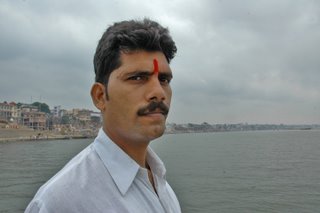
If Arun Pathak really wanted to kill himself, people in Benares say, he should have tied a heavier stone to himself before leaping into the Ganges. He could have also consumed a more potent concentration of sulphas and then jumped. And if he truly, badly, wanted to sacrifice his life because Deepa Mehta just wouldn't stop filming Water, his friends who stood by should not have dived in a moment later to rescue him. But because Pathak chose a light stone, and swallowed a substance whose lethality is disputed, and especially because he remembered to hand his wristwatch to the person beside him before jumping into the river, people are not convinced that he wanted to die. Death would have meant martyrdom, and martyrdom is of no use to a politician-in-waiting.
Six years have passed and Water has been completed. Pathak is 31 now, and still a politician-in-waiting. He lives in a tiny blue room on the second floor in the Jain dharamshala near Assi Ghat, and sleeps on the floor on a thin mattress beside his wife and his young daughter, Rakshita. The walls have several photos of gods, and a large one of identical Chinese twin babies. "As you can see it isn't air-conditioned, and if the people have problems with anyone they can come to me straight away," he says. These are two of Pathak's examples of how the country's ruling class has become: they sit in chilled offices and are unaccessible. Pathak says that even though he has very little, he and his supporters ensure justice for the ordinary man. "For example, if the police are harassing someone unnecessarily we make it stop, and we often get medicines and food for people and their babies. No one should suffer unnecessarily, no one should go hungry. But do our politicians understand this?" He says that on some days there is no food to eat at home, so the family sleeps off their hunger. But on occasion his daughter cries from hunger, and he leaves home on his Bullet. It sounds like bad parenting, but Pathak says he can't bear to hear his daughter cry.
Pathak's father is a storekeeper in the dharamshala, and his mother is a housewife whose sole possession is a sewing machine. His friends say he had a normal childhood, like their own, but was better than anyone else at speeches. "On Republic Day every year, my friends would dance and sing, but I would give speeches in clothes just like Nehru's. Then one day my teacher told me that I would become a politician," Pathak says. He abandoned school at the age of 14 and joined the Shiv Sena because "the Hindutva wave appealed to me, and I was told that new recruits would get a Mauser pistol. I was looking for that protection because every month I earned 30 Rupees which locals snatched away from me." He says he told his parents that he would return home late on some days and might not even return some days, to which he says, "They were worried. But when my name began appearing in the news they felt I was doing something good, and they made me guardian of the house."
The grown-up Pathak has a heavier frame than the one in the middle of the Ganges in pictures from six years ago. He has a full head of hair, dark eyebrows, small eyes, and thin lips that rarely shape into a smile. His arms and legs are scarred from police beatings and self-inflicted wounds. There is a nasty gash that runs across the middle of his left forearm, and on that arm is a finger he can no longer straighten. Like Mel Gibson, he revels in violence inflicted upon him, certain in the belief that it is for a greater good. "For my first major assignment we were to pray at [a temple (ed. could not understand his shudh Hindi)] in Ayodhya in 1994," Pathak says. "Two weeks before us Ashok Singhal was allowed to do it, but we weren't. The police would not let us near the temple because they thought our presence would instigate riots. So I cut myself several times. Along the way I cut a vein and a lot of blood flowed. Only then did the police let us in. I required 28 stitches." Pathak likes his violence in a controlled environment, where there is no danger of dying. He won't die in a police cell, he won't be killed by a lathi-charge, and he certainly won't kill himself. But without friends around him, he is not secure. One morning we were on a boat on the Ganges, and he refused to disembark on one particular ghat saying he "had enemies there." Asked to explain, he said they were "people who don't like the good work I'm doing."
Pathak launched the Kranti Shiv Sena in 2003, shortly after emptying and blowing up a bus carrying Maharashtrians. After 14 years of work with them, it was the Shiv Sena's 'Mee Mumbaikar' campaign against north Indians in Maharashtra that made him leave.While he remains upset with his old colleagues, it was under the Sena's shield that he was first recognised in 2000. "The BJP and the RSS had been talking about Water for a month, and the prime minister and chief minister had approved the film, but I managed to get a copy of the script. I found it very offensive. There was a line in it that said, 'Narayan, don't you know that if a brahmin or a god sleeps with a woman, she is blessed?' I thought to myself, 'I'm a brahmin, and I want to bless Nandita Das'." He says about lesbianism that "it is not Indian culture. Like we have Indian culture, there is also lesbian culture." Pathak gave Mehta 48 hours to pack up. "She was lucky I survived. Had I died, people would have torn her to shreds."
Over the years Pathak has gained a band of loyalists who have stayed with him through his attempts on his own life. In 1997, he took up a campaign to prevent alcohol shops from opening near holy sites, just like it was in Ayodhya. He climbed to the top of a 300-foot tall water tank in the Sigra district and threatened to jump. He says a crowd of 10-15,000 gathered to watch. The police arrived and gave him a note in writing that they would not allow the shops to open. "When I got down they tried taking it away from me, but I pretended that I had explosives strapped to myself. The police took evasive action immediately and I ran away, staying underground for two days. Then the matter passed."
On December 5, 1998, Pathak set off to do the Sena's work: put up flags and posters for a hindutva-based festival the organisation celebrated on December 6, the Babri Mosque demolition anniversary. PK Singh, the police official in charge of one district, told Pathak he could not put the flags up. Pathak decided he would, and hung his material above the police station that night. The next morning, Singh pulled everything down and stamped on it, and then had it burnt. Pathak saw his opportunity. He demanded Singh's transfer. When it did not happen, he barged into Singh's office and swallowed 50 sleeping pills. He woke up three days later and found out that Singh was still there. Pathak then lay down in front of the chief minister's motorcade after swallowing 50 more pills. He woke up to find the local superintendant of police had been transferred, but not Singh. "Singh shouldn't have stepped on our flags," Pathak said. "He did wrong." He defended disobeying the police's orders: "Who are they to tell us where we can and can't put up our flags? It's within our rights."
Pathak has a loose grasp of the constitution. We were discussing Valentines Day, which he believes should be outlawed because it is a western influence and, like lesbianism, alien to the Indian way. "How would you like it if someone gave your sister a rose," he asked. I replied it was up to her. "Wait and see. See how you feel when someone really does it. It's like a drug. It messes your mind." I asked him if individuals could make their own decisions in this matter. He replied that if it offended the majority of people, which it did, it should be banned.
Pathak has a way of finding a cause to die for on a perfectly normal day. The police in his area say that Pathak does exactly what they tell him not to. "One day we had cordoned off a street," a policeman said. "Pathak and his men came along and just lay there. They didn't do anything, but just lay there. When we dragged them away the press took pictures and it suddenly looked like they had been protesting." He knows politics is one big circus, a policeman says, and he's more than willing to perform.
Pathak's new visiting card is a saffron colour with the Indian flag stretched along the bottom. In the center is a three-quarter profile of him wrapped in an orange shawl, with a yellow circle, representational of the sun, behind him. "Our time is coming," he says. "Our time is close at hand. When a hindu or muslim baby dies of hunger, do our leaders come to visit?" During one interview session his phone rings. He hears it out and threatens to smack a minister with his shoes. Another time he says several thousands will converge and give ministers a hiding. "They've grown fat in office," he says. It's time for a change. "We must bide our time," he tells associates, "because it is coming soon."
Talking to Pathak is like listening to the ordinary man's utopia of political India, where corrupt ministers are disposed of in ruthless ways. He says that if he is elected, he will be like Anil Kapoor in Nayak. There will be food on every table, no one will be sick, no one will be corrupt. How he means to implement it isn't clear. Asked for a financial plan, he said, "some of my friends run small businesses, so they can handle it." There is no solution except revolution, and beatings by hand and feet.
People recognise Pathak now, but it amuses them that he made a spectacle of suicide. Nobody believes that he ever wanted to die, and Pathak has decided not to put his life on the line anymore. "I have thousands of people ready to do my work now," he says. The police estimate that his party has about 200 followers. Everywhere people give him free boat rides, free tea, free hotel food. But these people who love him stay too quiet, too stiff, around him. "He's a good man," they say softly, and leave it at that. But some talk. One, who ferries people, says he has to be nice to Pathak. Another, a shopkeeper, says standing in the same picture frame as Pathak is like taking a picture with a thief. A policeman from his district described him as "not a criminal, and not a politician either. He's somewhere between the two, if you know what I mean."
There is little doubt that Pathak has been a showman so that he can enter politics. But if he does enter it, there will be little, in terms of ideology, to differentiate him from those in the BJP and the Shiv Sena. Committing suicide to get in is one thing, it's staying alive respectfully in politics that's harder.
A somewhat edited version of this article was published in this week's issue of Tehelka, titled 'Yama, interrupted'. Photo by Lakshman Anand.

If Arun Pathak really wanted to kill himself, people in Benares say, he should have tied a heavier stone to himself before leaping into the Ganges. He could have also consumed a more potent concentration of sulphas and then jumped. And if he truly, badly, wanted to sacrifice his life because Deepa Mehta just wouldn't stop filming Water, his friends who stood by should not have dived in a moment later to rescue him. But because Pathak chose a light stone, and swallowed a substance whose lethality is disputed, and especially because he remembered to hand his wristwatch to the person beside him before jumping into the river, people are not convinced that he wanted to die. Death would have meant martyrdom, and martyrdom is of no use to a politician-in-waiting.
Six years have passed and Water has been completed. Pathak is 31 now, and still a politician-in-waiting. He lives in a tiny blue room on the second floor in the Jain dharamshala near Assi Ghat, and sleeps on the floor on a thin mattress beside his wife and his young daughter, Rakshita. The walls have several photos of gods, and a large one of identical Chinese twin babies. "As you can see it isn't air-conditioned, and if the people have problems with anyone they can come to me straight away," he says. These are two of Pathak's examples of how the country's ruling class has become: they sit in chilled offices and are unaccessible. Pathak says that even though he has very little, he and his supporters ensure justice for the ordinary man. "For example, if the police are harassing someone unnecessarily we make it stop, and we often get medicines and food for people and their babies. No one should suffer unnecessarily, no one should go hungry. But do our politicians understand this?" He says that on some days there is no food to eat at home, so the family sleeps off their hunger. But on occasion his daughter cries from hunger, and he leaves home on his Bullet. It sounds like bad parenting, but Pathak says he can't bear to hear his daughter cry.
Pathak's father is a storekeeper in the dharamshala, and his mother is a housewife whose sole possession is a sewing machine. His friends say he had a normal childhood, like their own, but was better than anyone else at speeches. "On Republic Day every year, my friends would dance and sing, but I would give speeches in clothes just like Nehru's. Then one day my teacher told me that I would become a politician," Pathak says. He abandoned school at the age of 14 and joined the Shiv Sena because "the Hindutva wave appealed to me, and I was told that new recruits would get a Mauser pistol. I was looking for that protection because every month I earned 30 Rupees which locals snatched away from me." He says he told his parents that he would return home late on some days and might not even return some days, to which he says, "They were worried. But when my name began appearing in the news they felt I was doing something good, and they made me guardian of the house."
The grown-up Pathak has a heavier frame than the one in the middle of the Ganges in pictures from six years ago. He has a full head of hair, dark eyebrows, small eyes, and thin lips that rarely shape into a smile. His arms and legs are scarred from police beatings and self-inflicted wounds. There is a nasty gash that runs across the middle of his left forearm, and on that arm is a finger he can no longer straighten. Like Mel Gibson, he revels in violence inflicted upon him, certain in the belief that it is for a greater good. "For my first major assignment we were to pray at [a temple (ed. could not understand his shudh Hindi)] in Ayodhya in 1994," Pathak says. "Two weeks before us Ashok Singhal was allowed to do it, but we weren't. The police would not let us near the temple because they thought our presence would instigate riots. So I cut myself several times. Along the way I cut a vein and a lot of blood flowed. Only then did the police let us in. I required 28 stitches." Pathak likes his violence in a controlled environment, where there is no danger of dying. He won't die in a police cell, he won't be killed by a lathi-charge, and he certainly won't kill himself. But without friends around him, he is not secure. One morning we were on a boat on the Ganges, and he refused to disembark on one particular ghat saying he "had enemies there." Asked to explain, he said they were "people who don't like the good work I'm doing."
Pathak launched the Kranti Shiv Sena in 2003, shortly after emptying and blowing up a bus carrying Maharashtrians. After 14 years of work with them, it was the Shiv Sena's 'Mee Mumbaikar' campaign against north Indians in Maharashtra that made him leave.While he remains upset with his old colleagues, it was under the Sena's shield that he was first recognised in 2000. "The BJP and the RSS had been talking about Water for a month, and the prime minister and chief minister had approved the film, but I managed to get a copy of the script. I found it very offensive. There was a line in it that said, 'Narayan, don't you know that if a brahmin or a god sleeps with a woman, she is blessed?' I thought to myself, 'I'm a brahmin, and I want to bless Nandita Das'." He says about lesbianism that "it is not Indian culture. Like we have Indian culture, there is also lesbian culture." Pathak gave Mehta 48 hours to pack up. "She was lucky I survived. Had I died, people would have torn her to shreds."
Over the years Pathak has gained a band of loyalists who have stayed with him through his attempts on his own life. In 1997, he took up a campaign to prevent alcohol shops from opening near holy sites, just like it was in Ayodhya. He climbed to the top of a 300-foot tall water tank in the Sigra district and threatened to jump. He says a crowd of 10-15,000 gathered to watch. The police arrived and gave him a note in writing that they would not allow the shops to open. "When I got down they tried taking it away from me, but I pretended that I had explosives strapped to myself. The police took evasive action immediately and I ran away, staying underground for two days. Then the matter passed."
On December 5, 1998, Pathak set off to do the Sena's work: put up flags and posters for a hindutva-based festival the organisation celebrated on December 6, the Babri Mosque demolition anniversary. PK Singh, the police official in charge of one district, told Pathak he could not put the flags up. Pathak decided he would, and hung his material above the police station that night. The next morning, Singh pulled everything down and stamped on it, and then had it burnt. Pathak saw his opportunity. He demanded Singh's transfer. When it did not happen, he barged into Singh's office and swallowed 50 sleeping pills. He woke up three days later and found out that Singh was still there. Pathak then lay down in front of the chief minister's motorcade after swallowing 50 more pills. He woke up to find the local superintendant of police had been transferred, but not Singh. "Singh shouldn't have stepped on our flags," Pathak said. "He did wrong." He defended disobeying the police's orders: "Who are they to tell us where we can and can't put up our flags? It's within our rights."
Pathak has a loose grasp of the constitution. We were discussing Valentines Day, which he believes should be outlawed because it is a western influence and, like lesbianism, alien to the Indian way. "How would you like it if someone gave your sister a rose," he asked. I replied it was up to her. "Wait and see. See how you feel when someone really does it. It's like a drug. It messes your mind." I asked him if individuals could make their own decisions in this matter. He replied that if it offended the majority of people, which it did, it should be banned.
Pathak has a way of finding a cause to die for on a perfectly normal day. The police in his area say that Pathak does exactly what they tell him not to. "One day we had cordoned off a street," a policeman said. "Pathak and his men came along and just lay there. They didn't do anything, but just lay there. When we dragged them away the press took pictures and it suddenly looked like they had been protesting." He knows politics is one big circus, a policeman says, and he's more than willing to perform.
Pathak's new visiting card is a saffron colour with the Indian flag stretched along the bottom. In the center is a three-quarter profile of him wrapped in an orange shawl, with a yellow circle, representational of the sun, behind him. "Our time is coming," he says. "Our time is close at hand. When a hindu or muslim baby dies of hunger, do our leaders come to visit?" During one interview session his phone rings. He hears it out and threatens to smack a minister with his shoes. Another time he says several thousands will converge and give ministers a hiding. "They've grown fat in office," he says. It's time for a change. "We must bide our time," he tells associates, "because it is coming soon."
Talking to Pathak is like listening to the ordinary man's utopia of political India, where corrupt ministers are disposed of in ruthless ways. He says that if he is elected, he will be like Anil Kapoor in Nayak. There will be food on every table, no one will be sick, no one will be corrupt. How he means to implement it isn't clear. Asked for a financial plan, he said, "some of my friends run small businesses, so they can handle it." There is no solution except revolution, and beatings by hand and feet.
People recognise Pathak now, but it amuses them that he made a spectacle of suicide. Nobody believes that he ever wanted to die, and Pathak has decided not to put his life on the line anymore. "I have thousands of people ready to do my work now," he says. The police estimate that his party has about 200 followers. Everywhere people give him free boat rides, free tea, free hotel food. But these people who love him stay too quiet, too stiff, around him. "He's a good man," they say softly, and leave it at that. But some talk. One, who ferries people, says he has to be nice to Pathak. Another, a shopkeeper, says standing in the same picture frame as Pathak is like taking a picture with a thief. A policeman from his district described him as "not a criminal, and not a politician either. He's somewhere between the two, if you know what I mean."
There is little doubt that Pathak has been a showman so that he can enter politics. But if he does enter it, there will be little, in terms of ideology, to differentiate him from those in the BJP and the Shiv Sena. Committing suicide to get in is one thing, it's staying alive respectfully in politics that's harder.
Thursday, July 06, 2006
Varnasi notes - Sati and staying alive
Come here, the guide says, let me show you something. There is a cow shed by the cremation ghat. It is dark, smelly, and the ground is slippery with urine. Look at that, he says, pointing to a staircase that leads into a black hole underground. A dim light is switched on to reveal a shivalinga in the middle of a small room. It is barely 3 feet wide and similarly long. When he took over the place, the guide points to the cow owner, he tripped over something. He dug and dug until he found the relic. He consulted ancient books which told him it was a sacred place where women threw themselves onto their husband's pyre.
***
The Nepali widows lay down a large bedsheet and talked in a jabber. Meri hindi khichdi, one said. Mine too, I told her. Using simple words, we talked about her life. She became a widow at 9, returned home to her mother who died 51 years later, visited Varanasi four times along the way and loved it. I used to feel so peaceful here, she said. And then I moved here for good. It was a terrible time. We cooked our own food if money was left after the rent. The rent was 300 a month. The Nepali government gave us 1400 for six months. Did I ever think of what? No, no, no, god forbid. Why sin that way? It's okay, you're young, you don't know better. But never ask a widow why she can't marry again. But I am happy now, all I want is moksha.
Varanasi notes - The death photographer
We were introduced to each other as the writer and the dead body photographer. He was a short and chubby man who worked out of a paan stall near the cremation ghat with a basic digital point-and-shoot and a very old SLR, the makers of which closed down long ago. His portfolio pictures included an old man with his eyes closed and mouth open with a backdrop of wood, and another man with his eyes open and a frown perhaps because the garlands around his neck were too heavy. There was another, of a bald boy holding up a lit torch beside a pyre ready to go. In the end, he said, there was no point in getting upset about your subject because it was all about business. "At first I used to be upset," he says with a smile, "because they were not alive. Gradually things changed, and I'm completely okay now." Besides these pictures he keeps no others for himself, or the police will take him away. But who needs pictures when moments stick? Once, a young girl was brought for cremation. She had an unhappy look. When he adjusted the lens, looking at her through the camera, he says she smiled. And then there are the weird ones: the man whose eyes popped out of their sockets ("I get those regularly"), the ones who were brought there by people unrelated. "With the way things are, you could bring the murdered here and nobody would ask you a question." Like others who deal with death regularly, he has overcome his initial hesitation by looking at things rationally. It's funny. When people can't handle something they usually find solace in God. But then presented with a side of God they can't handle, they often look for answers in rationality.
Sunday, July 02, 2006
Varanasi notes - The woman who wanted nothing, and the man who lost everything
We expect many widows there but find only one. She sits on her haunches at the door to an open floor overlooking the cremation grounds. The floor has a thin mattress, a bundle of belongings, and a stick. We ask her age. Ten years over a hundred, she says. At eleven years of age she was married to a government man who handled four temples along the river. He died when she was a child, and she raised the children. Her children have not forgotten. They persuade her to return, and she refuses everytime. Why should I go there? I have my dharma, and all I need are prayers. Two weeks ago a cow tipped her over, hurting her arm and chest. It was my destiny, she says. It's all been written. Now I wait to die. My grandchildren and children visit me. I don't want to leave Kashi. I want liberation.
***
The tout sat beside us while she talked. He teased her. She smiled at him. You're lucky she's in good spirits, he tells us, because she uses that stick quite a lot. She has an evil temper. He asks her with the mock genuineness of a reporter: tell us, what do you ask god for in your old age? None of your business, she shoots back. Alright then, he tries, which god do you pray to? She catches on and smiles: no priest has asked me that question, so how can you? Alright then, he says again, pray to god that he takes you happily. Her eyes bulge upon hearing this and she looks at him in horror. He smiles and she erupts in laughter. He makes sure she wears old age lightly.
***
The tout was on everything you can think of. His forearms still have scars that testify to years of drug abuse. I've left everything now, he says. He used to have a house, land, and lots of money, my own guide confirms. He traded in everything for a prolonged high.
***
The tout sat beside us while she talked. He teased her. She smiled at him. You're lucky she's in good spirits, he tells us, because she uses that stick quite a lot. She has an evil temper. He asks her with the mock genuineness of a reporter: tell us, what do you ask god for in your old age? None of your business, she shoots back. Alright then, he tries, which god do you pray to? She catches on and smiles: no priest has asked me that question, so how can you? Alright then, he says again, pray to god that he takes you happily. Her eyes bulge upon hearing this and she looks at him in horror. He smiles and she erupts in laughter. He makes sure she wears old age lightly.
***
The tout was on everything you can think of. His forearms still have scars that testify to years of drug abuse. I've left everything now, he says. He used to have a house, land, and lots of money, my own guide confirms. He traded in everything for a prolonged high.
Saturday, July 01, 2006
Varanasi notes - The river
Before we meet, the hopeful says, "Let us meet at the bank of the river. We will first dip our feet and then bathe there, and that can be the start of our relationship." My photographer has been near our proposed meeting point. You can go have a bath, he says, leave me out of it: I saw a dead woman floating there.
***
The next morning we get into a boat, tiptoeing over the green foam on the riverbank. The river smells stale, excrete floats by. Beyond the foam, a swimming instructor teaches students how to swim in water a solid shade of dark gray. In the middle of a monologue, the hopeful describes the spiritually purifying powers of the river. Merely taking its name is enough to cleanse you for seven births. He turns to wash his face with the river water, and then drinks it.
***
I cannot believe they swim in this.
***
Faith nearly kills. Three men from another state enter the river. They have sensitive skin. Two of them turn black, the third cannot move. He is rushed for medical care. None have recovered completely.
***
One man wants water purification through one system. The government wants it through another, and says the man's idea is too expensive. Authority has had a brainwave: let us release turtles in the river. There are two problems. Turtles consume only algae and seaweed. The town doesn't shit algae and seaweed.
***
The next morning we get into a boat, tiptoeing over the green foam on the riverbank. The river smells stale, excrete floats by. Beyond the foam, a swimming instructor teaches students how to swim in water a solid shade of dark gray. In the middle of a monologue, the hopeful describes the spiritually purifying powers of the river. Merely taking its name is enough to cleanse you for seven births. He turns to wash his face with the river water, and then drinks it.
***
I cannot believe they swim in this.
***
Faith nearly kills. Three men from another state enter the river. They have sensitive skin. Two of them turn black, the third cannot move. He is rushed for medical care. None have recovered completely.
***
One man wants water purification through one system. The government wants it through another, and says the man's idea is too expensive. Authority has had a brainwave: let us release turtles in the river. There are two problems. Turtles consume only algae and seaweed. The town doesn't shit algae and seaweed.
Friday, June 30, 2006
Varanasi notes - The boatman
We met yesterday. He was slightly inebriated at 10:30am. How can an ordinary human stand beside thieves, he had said when I asked him to join in a group picture at the tea shop. Meet me two hours later, he said then, remember, two hours. Eariler, the hopeful had said about the boatman when we met: "This man here? We are good friends."
Two hours later we looked high and low, he had disappeared.
***
We met today. "I don't remember what I said yesterday. And I always say too much when I'm drunk. What did I say to you yesterday?" He listened and then rowed for a while, saying nothing. We were in the middle of the Ganges at noon, just talking. He talked about Water, and the good money he would have made had Deepa Mehta not been chased away. His good friend is a nuisance around here.
***
The boatman's family had rowed boats across the river for over 400 years. His blue wooden boat was nearly 200 years old and still very sturdy. "It's made of sakkoo wood. From Nepal and Gorakhpur only." The boat will run for 300 years, he said, before singing quietly: "Sau saal padaa, sau saal khada, uske baad leke sau saal sadaa."
Varanasi notes - The hopeful
The train groaned to its final stop with a shudder 35 hours after it started, and its inhabitants escaped their cell in a furious rush. I met my interview subject, a local hopeful politician, a few hours later on the steps of a hotel. He was dressed in a safari suit, had shiny hair and a pandit's ponytail, and between his eyes was a red holy mark the size of a thumb print. As I approached, his eyes narrowed, the edges of his mouth curled up, his nostrils flared tensely, and his moustache bristled. It suddenly struck me that he was smiling.
***
The road to the hotel was blocked due to a rath yatra. So we took a shortcut but that was blocked too because of a mob that filled the street from edge to edge. It was a happy mob, the kind that would lower its voice in good neighbourhoods. But then they were screaming and laughing, perhaps at the demand they were making: that Sanskrit should be India's official language.
***
No more Valentines day if I come to power, the hopeful said. How would you like it if someone gave your sister a rose, he asked. I replied it was up to her. Wait and see, he said, see how you feel when someone really does it. It's like a drug. It messes your mind. It's not in our culture.
***
"Chhota prasad le aao," the hopeful said to his right-hand man in a tea shop. The man returned ten minutes later, gingerly holding a joint.
***
Everywhere he goes, people give him things for free. Tea, hotel meals, boat rides. "You can see how much people love me," he often said. But people who love him stay far too quiet. My gut feeling is that the man's a goon.
***
What kind of a man is he? The sub-inspector thinks it over and smiles. "He's not a criminal, and he's not a politician either. He's somewhere between the two, if you know what I mean."
***
The road to the hotel was blocked due to a rath yatra. So we took a shortcut but that was blocked too because of a mob that filled the street from edge to edge. It was a happy mob, the kind that would lower its voice in good neighbourhoods. But then they were screaming and laughing, perhaps at the demand they were making: that Sanskrit should be India's official language.
***
No more Valentines day if I come to power, the hopeful said. How would you like it if someone gave your sister a rose, he asked. I replied it was up to her. Wait and see, he said, see how you feel when someone really does it. It's like a drug. It messes your mind. It's not in our culture.
***
"Chhota prasad le aao," the hopeful said to his right-hand man in a tea shop. The man returned ten minutes later, gingerly holding a joint.
***
Everywhere he goes, people give him things for free. Tea, hotel meals, boat rides. "You can see how much people love me," he often said. But people who love him stay far too quiet. My gut feeling is that the man's a goon.
***
What kind of a man is he? The sub-inspector thinks it over and smiles. "He's not a criminal, and he's not a politician either. He's somewhere between the two, if you know what I mean."
Notes from a train
Around ten hours after the train left Mumbai, the train passed fields that were ready for rain. The skies were gray, and a darker shade in some parts. But there had been no rain yet and shrubs were dry and trees had a dusty, dull green colour. A village woman stood in one field by the tracks with her eyes closed and her hands together, praying. Several kilometers behind her was a particularly dark patch of cloud. Under it was the gray haze that signified rain. Nowhere else was there rain. Only behind her, near the hills in the distance.
***
The train compartment is empty, and there's no one to talk to on this 35 hour long journey. Because it is otherwise so quiet, one can hear conversations clearly: one voice complains to another, "Two poor guys have been running helter-skelter for a seat. And the ticket inspector is not helping them even though they have a reservation. He should do it for the sake of humanity."
At this point, an old man wobbles past my cubicle to join in the conversation: "If he does good," he says, "good will be done to him."
"Yes," the first man says, "but it's his duty to serve the people."
"If he does good," the old man repeats.
"But it's his duty."
"Good will be done to him."
The first man starts to say something and gives up.
"Yes, good will be done," the old man says again. "Bolo Hari Om, Hari Om."
The first man gives up. "Hari Om, Hari Om."
***
In Abna, by the rails, is a Muslim graveyard. It is at the edge of the village. In Kutch last year, at the edge of another village, stones were stacked in tiny mounds on the side of a dune. The guide said they were the graves of sweepers, who only other sweepers could bury. The untouchables and the dead share this: already lost to us, let us properly send them on their way. Somewhere out of sight, somewhere we'd rather not know, preferrably.
***
The train stops at Surgaon Banjari for two hours. It is past six and the sun has begun to set. For an hour before darkness sets in, most of the desolate landscape turns a shade of yellow: metal, stone, and cement. It is so far from anywhere. For two hours we shift from one seat to another, restless, trying to catch a better view. But how can that happen when everything looks the same? So who lives here? Why? I suppose we all live in places that offer us something. Whether it is wealth or a chance to dream our life away.
***
The train pulls into Allahabad Station. What a dump.
***
The train compartment is empty, and there's no one to talk to on this 35 hour long journey. Because it is otherwise so quiet, one can hear conversations clearly: one voice complains to another, "Two poor guys have been running helter-skelter for a seat. And the ticket inspector is not helping them even though they have a reservation. He should do it for the sake of humanity."
At this point, an old man wobbles past my cubicle to join in the conversation: "If he does good," he says, "good will be done to him."
"Yes," the first man says, "but it's his duty to serve the people."
"If he does good," the old man repeats.
"But it's his duty."
"Good will be done to him."
The first man starts to say something and gives up.
"Yes, good will be done," the old man says again. "Bolo Hari Om, Hari Om."
The first man gives up. "Hari Om, Hari Om."
***
In Abna, by the rails, is a Muslim graveyard. It is at the edge of the village. In Kutch last year, at the edge of another village, stones were stacked in tiny mounds on the side of a dune. The guide said they were the graves of sweepers, who only other sweepers could bury. The untouchables and the dead share this: already lost to us, let us properly send them on their way. Somewhere out of sight, somewhere we'd rather not know, preferrably.
***
The train stops at Surgaon Banjari for two hours. It is past six and the sun has begun to set. For an hour before darkness sets in, most of the desolate landscape turns a shade of yellow: metal, stone, and cement. It is so far from anywhere. For two hours we shift from one seat to another, restless, trying to catch a better view. But how can that happen when everything looks the same? So who lives here? Why? I suppose we all live in places that offer us something. Whether it is wealth or a chance to dream our life away.
***
The train pulls into Allahabad Station. What a dump.
Monday, June 26, 2006
Sunday, June 25, 2006
After the big bang
When I was in advertising, there were reminders of how good one could be. It wasn't the superficial, shallow, industry it was often made out to be, but a place where you could go nuts with your imagination. This advertisement is one of those reminders, and it won the top award at Cannes last night. Do watch it.
Ps. It's titled 'noitulove'. Heh.
Ps. It's titled 'noitulove'. Heh.
Saturday, June 24, 2006
Guns and poses
This appeared in the Tehelka issue dated 24 June 2006
Last week, within minutes after the shot fired in Mahesh Bhatt’s office, a gangster by the name of Ravi Prakash Surya Poojari rang up news correspondents claiming responsibility for the incident. It was the traitor’s good fortune he was not there, Poojari said. He got lucky. He wouldn’t miss next time. The thing is, it had all been heard before. Poojari often levitated to the media with dramatic statements of intent. He relied on the press to give him new life as a criminal.
Bhatt was in Delhi, addressing “a conference on the awareness of elderly abuse”, when he heard the news. He thought it “funny and absurd and bizarre and comical and a mixture of all these emotions at once”. Apparently, a boy had come into his office, asking for him. He was fidgety. Then he turned impatient. He was told Bhatt wasn’t in. He ran out of the office, pulled out a country-made gun, and fired at nothing in particular. If you can’t find the traitors, the message went, at least put a bullet through their veneer floor.
“It’s a little bizarre,” Bhatt said. “Why did he choose to shoot when I wasn’t there? Did he actually come to shoot me and kill me, or was it to announce that he was around? Was it a dreaded gangster doing it of his own free will, or was he nudged by somebody who wanted to muzzle the voice of an individual who has spoken fearlessly about the atrocities committed against minorities of every kind?”
Poojari, a Karnataka boy, is 35 now. When he was last arrested, in 1994, aged 23, he already had four years of crime to his credit. He stayed in the Jan Kalyan residential Society in Andheri, with parents who knew what he was up to. He fell in love with and married a Punjabi woman who knew what he did. And he had children who knew his profession. The family was called in for questioning a few days after the incident at Mahesh Bhatt’s office.
Poojari had spent a month planning Bhatt’s death, and said his days were numbered. “Jab main kisi aadmi ke peechey pad jata hoon to usey chodta nahin hoon,” Poojari said over a telephone to a television channel. He said Bhatt was anti-India and had connections with the Inter Services Intelligence. His hitlist was long, he said, and Dawood was on it, besides other Muslim builders. Also on it was Majit Memon, the lawyer, who survived an attempt on his life last year (Incidentally, Poojari had spent a month tracking Memon and then went to the press after missing his target). He claimed that once they were dead he would surrender. This, an officer investigating Poojari said, was like advertising. “You know how brands create identities? That’s what he’s doing. He’s no big nationalist. He goes around threatening Hindus. What kind of a nationalist is that?”
The police believed that Poojari did it for attention. “He used to bring tea and buy vegetables for Srikant mama,” a senior inspector at the Mumbai crime branch said. Srikant Desai was a gang leader. “When mama passed away in an encounter in 1993, Poojari thought Bala Zalte, brother of the gangster Bandya Zalte, had tipped off the police, so he murdered Bala.” It was a brutal killing. A dozen men, including Poojari, used swords. One by one the men were arrested and, based on a tip-off, they finally arrested Poojari when he visited home to see his newborn daughter at his MIDC residence in Andheri. “You could see cruelty in his eyes. What kind of a man kills a person that way?” But cruelty in the eyes is not permissible evidence, and he was acquitted a few months later. He fled the country in two years.
The police thought he was somewhere in India now, doing what he did best: extortion. The problem was that Poojari’s stock was a tad low in the police’s eyes. “Just imagine,” the officer recalled with a chuckle, “he called up some guy and said, ‘Give me 50 lakhs.’ The guy said no, so he said, ‘Okay, give me 25 lakhs,’ and the guy said no again, and he said, ‘Alright then, give me five lakhs,’ which the guy agreed to. Then he sends two of his boys, young boys, and we picked them up.”
Poojari had parted ways with Chota Rajan after an attack on him by Dawood’s men in Bangkok, supporters had left him en masse, and he needed people to know that he was around. He needed the publicity to spread fear. He hired young boys, luring them with cell phones and a bundle of cash, and left them cold if they were unlucky. “He never helped his assistants,” the inspector said, “and so they didn’t trust him. They left him.” Then, tiring of the questions, he sighed and said, “Why don’t you just speak to him? He’s given just about everybody his contact number.”
The small life
This appeared in the Tehelka issue dated 24 June 2006.
There’s no need to turn that on, Ishrat said, looking at the voice recorder on my palm. She chewed gum and rarely made eye contact and, when she spoke, flicked the gum to one side in a polished maneuver so it remained hidden. But with the recorder, she made eye contact and forgot to flick. “Is it really necessary?” she asked uneasily, her voice nearly lost in the mall’s din. When I told her that it was, she stiffened and gave the device a frown that looked like a smile. “You should use your memory instead of this thing. Why me? I don’t know why you find me interesting.”
Ishrat was starting out in the television industry with a bit role in a daily serial. As a child, she was the movie star while her friends played doctors and nurses. Three months ago she arrived in Mumbai from Bareilly hoping to act. Her father, an army man, was dead. At some point, after performing theatre endlessly in Delhi, she told her mother what the mother had always expected. It was her first visit to the city. “I was scared, but then my friends who had come here helped me with phone numbers and a place to live.” She visited producers’ offices for a few months, and while no clear offer was forthcoming, she claims to have known that things would work out. I asked her how she knew this. “I just knew.” Until the offer was finally made, she said, you can’t imagine what it was like. When I asked her what it was like, she waved her arms but could not find the words. She denied immediately, emphatically, that producers had made physical overtures. “My friends had advised me not to meet producers at their homes or in cars, only in public places and their offices. In any case, when I sensed something was wrong, I ran the other way.”
Many others don’t. They turn around to run and find others clamoring for the opportunity they considered giving up. So they take a deep breath and stay. The small screen’s the big picture, and everything that comes with it is manageable, probably more manageable than where they came from. It may have started with a glorious dream, but then most things in television start that way. In the end it all comes down to a rational decision.
I met Kamlesh Pandey at his home. Barely had we begun talking when his phone rang. Hindi books lined his shelf, a series of them broken by Naguib Mahfouz’s Palace of Desire. Trophies from advertising and film lined one wall, interspersed with pictures alongside Rajiv Gandhi when his hair was a good deal less wispy. A little later he ended the conversation, slouched on his sofa and, running one hand through his hair, declared, “The problem is the good actors are busy while the others are bad.” He said there were too many people who came from small towns knowing nothing about how the camera worked, how television operated. Too much mediocrity. Pandey is now known as the writer of Rang De Basanti, but once left advertising to become creative head at Zee Television in the early 90s, against the advice of friends like Shekhar Kapur and Alyque Padamsee. “There are too many people. My advice to them is, if they can do anything besides acting, they should take it up.”
Pandey had probably seen Lokhandwala. It is a suburb of shops and no trees, of dug up roads and no pavements, of limitless cars and no signals. There is little inspiration in the architecture here, old buildings are built from the same template of repetition and boxy thinking, and new structures are made of glass and boxy thinking. You could say it’s the suburb most suited to television’s ways. It is unavoidable for anyone connected to TV serials. Television stars work and live and eat and talk over coffee. So aspirers swarm to the area. They can be found in the main marketplace. They are the worked-out kind, the ones with a practiced walk and look, wearing their finest clothes while purchasing pudina and baingan. Everyday they flirt with discovery in this mass screen test. They leave their portfolio shots with serial producers and wait by the phone. Going by Pandey’s belief, they’re sure to find employment. Going by Ishrat, it’s not easy. But going by Ashish Nayyar, a dream fulfilled doesn’t make for an entirely fulfilling dream.
Nayyar was lying down on a narrow bed in a room the size of a large wardrobe, waiting for his scenes in the serial Tumhari Disha, when I met him at Future Studios. He played the lead, DK, a man with a fine peppery French beard and a wicked limp. A cluster of papers lay on the bed, a small frosted glass window above permitted minimal daylight, and naked bulbs bordered a mirror on one wall. The fluorescent tube’s white light muted the room, imparting a studious feel to it.
“Sometimes you get really frustrated and think, ‘What is this? What am I doing here?’ because you come into a makeup room which is, as you can see, 4 x 4,” Nayyar said. “It’s like a cell. I sit here the whole day and wait for the shots to happen. I don’t know for how many days I haven’t seen sunshine. And I don’t know what it feels like to be outside at noon.” He keeps aside two hours every night for himself. “My escape hours are from ten to twelve. I’ve adjusted my life to that”.
Not everybody in television has a life outside it. For instance, staff at Balaji Telefilms, Ekta Kapoor’s production house, often coincide their working hours with Kapoor’s, and she starts late in the evening. So people try to keep up but fail and leave, and join elsewhere and realize it’s all the same. Episodes need to be completed in one or two shifts wherever they go. Directors receive the day’s script minutes before the shoot commences. Actors receive their lines minutes before they are on camera. During the talk with Nayyar, the door opened three times in half an hour. The first time, the line prompter popped in to ask if he had prepared his lines. Ten minutes before Nayyar was due on the sets, the prompter returned with a new dialogue sheet. “See?” Nayyar said. “This is how things work.” Minutes later, as the actor settled down to learn his lines, the prompter came back to announce that they were going with the original lines.
Like this, like the story of many other actors, directors, writers, and technical men, Nayyar worked 14 hours a day for 25 days every month. Work blurred the line between Sundays and Mondays, and more dangerously, it made the distinction between DK and Nayyar less clear. “When you involve your mind on something and focus your conscious on it, you gradually begin to live that life subconsciously too,” Nayyar said. “This definitely takes a toll on your family and personal life, because you are not the person they know. You are a different person. I argue with my wife and friends. They ask me why I’m behaving a certain way. They say, ‘You’re not DK, you’re not shooting anymore’. I tell them I can’t help it. Two hours is not enough time for me to get out of the character that I’ve been living for two and a half years.
“So it is taxing, but it is fulfilling because I enjoy myself. But there are people who are not enjoying what they do. They are killing themselves inside. I see these newcomers do roles that they really don’t want to do. I’m sure they must be in bad shape mentally.”
Some get lucky. In Lokhandwala, I met a young actor, Sushmita Daan, who found success early in the serial Saans, in which she played Neena Gupta’s daughter, a teenager who had passed her tenth grade. Her own life was similar, and she clearly enjoyed being a known face. “Just imagine. Everybody in your college knows you. You’re a celebrity!”
While it is celebrity and the accompanying finances that attract people to television now, a decade ago it was likely to be only celebrity. Estimates vary, but top actors are said to earn over 10 lakhs a month. Other serial actors are routinely paid over 40,000 for a day’s work whereas once the going rate was 5-7,000 for an episode. The downside then was that if your role in that particular episode was editable, it was very likely to be cut. But the number of channels has grown, there are more jobs now, and even dialogue writers are paid around 5,000 an episode. It is a viable career option, preferable for many to films where careers are built and demolished on a single Friday. And the recognition is heady. Television stars are more easily identifiable and, given their daily appearance in our homes, have an audience less demanding about acting ability. Some actors I spoke to admitted that they switched off on some days without worry because they could raise their level the next. Directors often recognize this but are themselves caught up in the relentless cycle of producing an episode a day, and therefore sacrifice quality for speed.
Television serials rely less on art or craft than on productivity. Shifts, in general, go on for longer than half a day, and the emphasis is on churning out episodes keeping in mind the current trends of viewers. At TAM, the market research company set up to monitor television ratings, an employee explained that with their ability to monitor ratings every minute could bring up interesting insights. For example, was a particular monologue not interesting enough? This instant observation could be conveyed to the production house and they, in turn, make changes to the script immediately. With everything in such flux, the director – not the most important man in television these days – often sees the day’s script for the first time only minutes before filming begins.
When I visited the sets of Miilee at Kamal studios, the unit director was slumped in his chair, devoid of any energy. The simplest movement placed great strain on him, and when things went wrong he would close his eyes and yell out resignedly. Phones went off in the middle of scenes, extras giggled during serious shots, lines went missing from the script, rain threatened to ruin expensive equipment, and aluminum reflectors with serious razor edges were blown across the sets by the monsoon wind. But whatever happened, he remained rooted to his chair, as if the job’s weight had pinned him physically, crushing his spirit. I had not met a heavier man before. Watching the scenes that unfolded, it was easy to empathize with him. His assistant shouted lines at extras meant to be reporters. “Bolo, ‘woh dekho, Miilee”. The four extras looked this way and that at each other and repeated the line. “Bolo, ‘itni aasaani se apne aap ko police ke hawaale kar diya?’”. They did as instructed, attempting it earnestly but failing miserably. It seemed a joke on reality. Both lines were approved in one go. It is a particular, and often peculiar, kind of person who truly believes in the television he creates these days. This thing is not in his hands. It is not at all grounded.
Ajai Sinha was caught between two ways of thinking when I met him at his Lokhandwala home. He was guarded at first but after sipping a cup of steamy tea he warmed to the conversation. Sinha was the director and producer of Astitva, a serial that gathered a small but intelligent fan following in its three years on air. It came to be regarded as one of the best ever on Indian television, and one of the show’s writers believed that the circumstances and conditions that came together to make Astitva would be difficult to replicate. Sinha himself was pretty certain that “seeing today’s scenario and the audience we have, I don’t think anything like Astitva will ever be made. It’s a negative thought, but, you know, it never rated more than 2.5 ratings points, and in general from 1 to 2.” Pause. “I feel that television is beginning to focus on ordinary things, nothing above the intelligence of the ordinary man.” Astitva did not appeal to many, it was not strictly family-oriented – as was and is the norm – and the issues it dealt with were not everyday serial scenarios which are derived from mythology. It was, in every sense, a rare show. So when it concluded in early 2006, Sinha came to a crossroads. For a while, without my prompting, he spoke about the lopsided relation between intelligence and rewards in television. A lot came from fact, but then a lot also came from somewhere deeply personal.
“It has become difficult to do that kind of work,” Sinha said. “Who will do it? Neither is there anyone left to produce it, nor does anyone have the courage to broadcast it.” The dilemma was this: on the one hand, creating popular programming meant sacrificing a loyal audience eager for thoughtful television. On the other, it meant making money for the people “who had supported me during Astitva”. He alluded to Zee TV. “It has become difficult. When the audience of Astitva sees my next serial, they will be dejected. They will wonder where the Ajaiji they knew has gone.”
A large number of people I spoke to were critical of TAM’s ratings system. Vinta Nanda, who wrote Tara, a unique serial in the mid-90s, called it “a complete sham”, citing the sample size as too small. How could 4,000-odd families with people meters charting every channel change on their television sets possibly represent the entire country’s viewing habits? “Everybody I met told me they liked Astitva,” Sinha said. “So there’s either something wrong with the program, or with the ratings.” But he also believed that a deeper malaise lay behind the ratings. “There isn’t a problem with the watcher. It is a social and political problem. I might be going a little off-track, but look at the country’s leaders. I don’t mean politicians, but all the people who are responsible for the nation’s growth – they’ve not found it important to help people think for themselves. It’s like, if people stay stupid, they will always listen to you.”
This view was, in part, agreed to by Nanda who left Zee Television ingloriously and returned as creative head in 2001 before leaving it soon after. We met at her Versova office, a small but considerably cluttered space with cracked walls and peeling paint, a place she called “Beirut”. She settled on a couch that had shape-shifted to accommodate her over time, and produced a talk – that outlasted her cigarette – on the damaging effects of modern popular soaps. “If somebody asked me right now whether I wanted to do television, I would say no.” At the time she moved from theatre, “television was Hum Log, television was Buniyaad, it was Yeh Jo Hai Zindagi.” Quality had dive-bombed since. “Cinema picked up when television filled audiences with superstition, double-standards, and regressive behavior.” Nanda says that channels grew too big too soon, and this in turn brought in a wave of the less talented who took the place of genuine talent, and so mediocrity became the norm. Then there was the money, which took center stage on television. “No harm done because it drives the economy, but what happens on screen, one has to realize, has a huge impact on the population which is struggling to survive and change. That impact has been terrifying in the last five or six years because instead of progressing, it has brought about a regressive impact on every upwardly mobile individual.” I asked her how should could tell. “I do see proof of it around me,” she said slowly, explaining that while women strove for economical independence, television, from where they received most of their messages, presented a regressive view. “Hypocrisies and double-standards are underlined as your strengths. Then you’re in big trouble.”
The saas-bahu serials Nanda is referring to are currently the most popular shows on air, rating anywhere between 10 and 15 ratings points. What keeps them going is a combination of enticing hooks, intriguing turns in plot, and sometimes, the scarcely believable. For instance, at a press conference by Balaji, the production house behind Kyonki Saas Bhi Kabhi Bahu Thi, we were informed that the show would take a 20-year leap, that Smriti Irani’s 55-year-old character Tulsi would die, that a talent search would be conducted for Tulsi’s replacement Krishnatulsi, and that Irani herself would return as a 70-year-old character named Baa. Irani, in reality, is under 30.
The developments keep watchers occupied, but in Irani’s case, the risk taken by killing her off and then reincarnating her is driven by the audience’s attachment with her. In 2005, when it was rumored that Tulsi would be eliminated, a newspaper hit the streets to gauge general reactions, and this is what they heard:
Even then, audiences are attuned to suspending logic. Actors are changed routinely when things come up: a new role, a new career, a falling out with the producer. “It happens in film all the time,” a television analyst said. “Ram Gopal Varma has a fight with Urmila and never again uses her in his films. But you don’t notice it because films have a narrative three hours long. In television, they go on for so long that things are bound to happen.”
But often, the familiarity that television watchers have with characters is often so intense, the distinction between the actors and their life blurs. Gajra Kothari, a writer for the serial Astitva, recalled how Niki Aneja, who played Dr. Simran on the show, was often approached by strangers who glowingly told her they approved of her medical decisions.
I met Alok Nath, who suffered from an extreme case of this recognition. Nath was recognized for his portrayal of Haveliram, an old man, in the serial Buniyaad. So he was disturbed when producers and directors came to him with similar roles. Had he said no, he explained, it would mean discomfort, for he had married after Buniyaad, and money was certainly important. Imdb.com describes his roles since then: Pooja’s dad (2005), Tarun’s dad (2005), Father (2005), Ramchand’s dad (2003), Esha’s granddad (2003), Rohit’s dad (2002), Bauji (2001), Rohan’s grandfather (1999), Priya’s dad (1995), Raja’s dad (1993) – Raja, in real life, was only 13 years younger than Nath at the time.
Taken in by Nath’s frail characters on television, I was surprised by his physical presence when I paid him a visit. He filled half a large sofa comfortably, and remained seated through the conversation, moving only his fingers from his knee to his mouth for a quick drag, and then for a drink. His other hand he used imaginatively to gesture and explain. “I’m always doing a goody-goody kind of role, a good friend, a good teacher, a police officer or a good father, a good grandfather now, the babuji, the pitaji. It’s been happening for the last 30 years. Nobody wants to take a risk because there’s huge money involved. Nobody wants to disturb the applecart. They just want things to remain the way they are. Let’s say, just for the heck of it, that they want me to play the role of an evil doctor. Their boss would say no straightaway, and say that Alok Nath might be a good doctor, but this audience of ours is not receptive to it.
“One major thing that I’ve noticed is that when you’re working on television and are in the audience’s midst, they watch you lying down, they watch you eating. They feel they can reach out and touch you. That you’re a part of their being. If you’re a bad guy and you get a good guy’s role, people appreciate it. But if a good man does a bad man’s role, they’ll say ‘yaar, achcha khaasa role tha, why is he doing a villain’s role?’ So you have to literally play to the gallery.”
Nath says there was no other way. With a young family and increasing pressure from competitors, turning down offers would have meant facing difficulties in an expensive city and returning to the precarious financial state he had known before three days of work in Richard Attenborough’s Gandhi brought him Rs 20,000. He seemed aware that the decision was his alone to make, and the repercussions were his alone to bear. Between idealism and reality he chose to live comfortably, if not comfortably with himself.
“You become like this. You can’t settle for lesser, and in not doing so, you have to accept the kind of work you are getting. Ten years earlier you could have said no to a certain kind of work because your demands were lesser. But you reconcile to the fact that you need the money to survive. And if you’re not working, there are fifty people who will jump at that role, and at a lower price. So there is a huge amount of disillusionment, you sometimes do work that doesn’t give you pleasure, which doesn’t satiate your creativity. But you work compulsively because you know that there will be a paycheck for you at the end of the day, and this makes survival easier.”
What went unsaid in this and other conversations was Ekta Kapoor’s influence on an actor’s survival. Her Balaji Telefilms was an employment machine. Actors routinely found themselves in and out of favour, and in and out of a job. Being out of the Ekta camp, as the newspapers put it, you find yourself in a hostile wilderness.
At the end of my first round of meetings with scriptwriters, actors, and directors, it was clear that several of them had chosen a living in television because it was lucrative. It had attracted people from everywhere, including those who had nothing to do with it, Nanda had said in ‘Beirut’. “The requirements for being a writer these days,” said Kothari, the writer of Astitva, were not an ability to write well or understand the language, but “how many hindi movies you have seen. Because that’s where they lift from.”
“Anybody can be a writer in this industry,” a young but depressingly cynical Hindi writer said during a conversation, “and usually they do. Even you could become one.” While it demanded people’s time and took away their life outside television, it left them wealthy; a fair trade for most people I had met. “Very early in life I knew I’d have to choose between theatre and money,” the writer said, “and I knew the life I wanted.” He then proceeded to recite dialogues loudly from his historical serial over coffee in a crowded cafe, demonstrating that while he had abandoned drama, his instinct for drama had not left him.
This cynicism was present in varying degrees from the young to the more experienced. It seemed an acquired thing, the result of fresh ideas and dreams checked by a sour dose of reality. Half expecting her answer, I anyway asked Kothari whether she had any advice for newcomers with dreams of effecting social change on television. She laughed and recommended an urgent reality check.
This is not to say that the state of television always brought on the blues. Kamlesh Pandey, who wrote Rang De Basanti, said, “Satellite television was like the new girl in the neighborhood, and I wanted to know what she was all about.” Later he described the helplessness of a television writer’s job with a brutal metaphor about TRPs: “It’s like making love to a gorilla; you don’t stop when you want to, you stop when it wants to.”
In the years since his departure from Zee it became clear that everyone in television was dating the same gorilla. Pandey left because he couldn’t relate to the new ideals of television. Not left, he corrected me, but did a few things. But his time at Zee, and Zee at the time, he says, was brilliant. “Being young had its advantages. We didn’t know what we couldn’t do, we had no idea. The whole world was wide open. We could take risks. I had a small team, a young team, full of girls, and we had the advantage of no satellite competition, so it was not very difficult. We were not bogged down by the idea of TRPs. And the only competition was Doordarshan, who were in any case in a disastrous situation because of corruption and other things.” Several memorable programs were commissioned: “Campus, Banegi Apni Baat, Tara, Philips Top Ten, Daak Ghar, The Zee Horror Show.” It was the only Indian satellite channel on air, and people loved them, Pandey said. They received over 300,000 letters a week and kept a record of letter-writers for future reference until the idea collapsed under an avalanche of mail.
Doordarshan had fallen from grace quickly. In the 1980s, Doordarshan, free from rivals, ran programs that, Pandey said, represented the best of Indian television. Some attributed it to the high quality of writers and actors, some to directors like Ramesh Sippy and Shyam Benegal, and some reasoned that because the decade was a particularly torrid one for cinema, talent found an outlet on television. “I think that was the golden age of television. What we have right now on satellite television are me-too shows. If one guy does something, the other guy immediately duplicates it under another name. It’s sad, but if you remove the channel’s logo, you wouldn’t know which network you were watching.” But gradually, Pandey said, things were changing. Recently approached by Ekta Kapoor – whose first serial Hum Paanch was commissioned by him – to work on a serial called Sati, he mentioned that Kapoor was anxious to change and try things other than the usual family dramas.
This view was countered by a serial writer who had been in the business long enough. “They always start off wanting something new, but gradually they try and mould you to fit their style, and then you’re left with the same old thing.” While the inclination is there, it is the market that finally decides what stays on air.
It is for this reason that blame can’t be found either with channel heads or with production houses. The tastes they cater to are diverse, competition is intense, and marketers are sensitive to the slightest rise and fall in a channel’s fortunes. So things remain steady, and innovations remain rare. Pandey himself mentioned how difficult the task of deciphering audiences was: “It’s like that American saying.” Pause. “No one knows anything.”
There’s no need to turn that on, Ishrat said, looking at the voice recorder on my palm. She chewed gum and rarely made eye contact and, when she spoke, flicked the gum to one side in a polished maneuver so it remained hidden. But with the recorder, she made eye contact and forgot to flick. “Is it really necessary?” she asked uneasily, her voice nearly lost in the mall’s din. When I told her that it was, she stiffened and gave the device a frown that looked like a smile. “You should use your memory instead of this thing. Why me? I don’t know why you find me interesting.”
Ishrat was starting out in the television industry with a bit role in a daily serial. As a child, she was the movie star while her friends played doctors and nurses. Three months ago she arrived in Mumbai from Bareilly hoping to act. Her father, an army man, was dead. At some point, after performing theatre endlessly in Delhi, she told her mother what the mother had always expected. It was her first visit to the city. “I was scared, but then my friends who had come here helped me with phone numbers and a place to live.” She visited producers’ offices for a few months, and while no clear offer was forthcoming, she claims to have known that things would work out. I asked her how she knew this. “I just knew.” Until the offer was finally made, she said, you can’t imagine what it was like. When I asked her what it was like, she waved her arms but could not find the words. She denied immediately, emphatically, that producers had made physical overtures. “My friends had advised me not to meet producers at their homes or in cars, only in public places and their offices. In any case, when I sensed something was wrong, I ran the other way.”
Many others don’t. They turn around to run and find others clamoring for the opportunity they considered giving up. So they take a deep breath and stay. The small screen’s the big picture, and everything that comes with it is manageable, probably more manageable than where they came from. It may have started with a glorious dream, but then most things in television start that way. In the end it all comes down to a rational decision.
I met Kamlesh Pandey at his home. Barely had we begun talking when his phone rang. Hindi books lined his shelf, a series of them broken by Naguib Mahfouz’s Palace of Desire. Trophies from advertising and film lined one wall, interspersed with pictures alongside Rajiv Gandhi when his hair was a good deal less wispy. A little later he ended the conversation, slouched on his sofa and, running one hand through his hair, declared, “The problem is the good actors are busy while the others are bad.” He said there were too many people who came from small towns knowing nothing about how the camera worked, how television operated. Too much mediocrity. Pandey is now known as the writer of Rang De Basanti, but once left advertising to become creative head at Zee Television in the early 90s, against the advice of friends like Shekhar Kapur and Alyque Padamsee. “There are too many people. My advice to them is, if they can do anything besides acting, they should take it up.”
Pandey had probably seen Lokhandwala. It is a suburb of shops and no trees, of dug up roads and no pavements, of limitless cars and no signals. There is little inspiration in the architecture here, old buildings are built from the same template of repetition and boxy thinking, and new structures are made of glass and boxy thinking. You could say it’s the suburb most suited to television’s ways. It is unavoidable for anyone connected to TV serials. Television stars work and live and eat and talk over coffee. So aspirers swarm to the area. They can be found in the main marketplace. They are the worked-out kind, the ones with a practiced walk and look, wearing their finest clothes while purchasing pudina and baingan. Everyday they flirt with discovery in this mass screen test. They leave their portfolio shots with serial producers and wait by the phone. Going by Pandey’s belief, they’re sure to find employment. Going by Ishrat, it’s not easy. But going by Ashish Nayyar, a dream fulfilled doesn’t make for an entirely fulfilling dream.
Nayyar was lying down on a narrow bed in a room the size of a large wardrobe, waiting for his scenes in the serial Tumhari Disha, when I met him at Future Studios. He played the lead, DK, a man with a fine peppery French beard and a wicked limp. A cluster of papers lay on the bed, a small frosted glass window above permitted minimal daylight, and naked bulbs bordered a mirror on one wall. The fluorescent tube’s white light muted the room, imparting a studious feel to it.
“Sometimes you get really frustrated and think, ‘What is this? What am I doing here?’ because you come into a makeup room which is, as you can see, 4 x 4,” Nayyar said. “It’s like a cell. I sit here the whole day and wait for the shots to happen. I don’t know for how many days I haven’t seen sunshine. And I don’t know what it feels like to be outside at noon.” He keeps aside two hours every night for himself. “My escape hours are from ten to twelve. I’ve adjusted my life to that”.
Not everybody in television has a life outside it. For instance, staff at Balaji Telefilms, Ekta Kapoor’s production house, often coincide their working hours with Kapoor’s, and she starts late in the evening. So people try to keep up but fail and leave, and join elsewhere and realize it’s all the same. Episodes need to be completed in one or two shifts wherever they go. Directors receive the day’s script minutes before the shoot commences. Actors receive their lines minutes before they are on camera. During the talk with Nayyar, the door opened three times in half an hour. The first time, the line prompter popped in to ask if he had prepared his lines. Ten minutes before Nayyar was due on the sets, the prompter returned with a new dialogue sheet. “See?” Nayyar said. “This is how things work.” Minutes later, as the actor settled down to learn his lines, the prompter came back to announce that they were going with the original lines.
Like this, like the story of many other actors, directors, writers, and technical men, Nayyar worked 14 hours a day for 25 days every month. Work blurred the line between Sundays and Mondays, and more dangerously, it made the distinction between DK and Nayyar less clear. “When you involve your mind on something and focus your conscious on it, you gradually begin to live that life subconsciously too,” Nayyar said. “This definitely takes a toll on your family and personal life, because you are not the person they know. You are a different person. I argue with my wife and friends. They ask me why I’m behaving a certain way. They say, ‘You’re not DK, you’re not shooting anymore’. I tell them I can’t help it. Two hours is not enough time for me to get out of the character that I’ve been living for two and a half years.
“So it is taxing, but it is fulfilling because I enjoy myself. But there are people who are not enjoying what they do. They are killing themselves inside. I see these newcomers do roles that they really don’t want to do. I’m sure they must be in bad shape mentally.”
Some get lucky. In Lokhandwala, I met a young actor, Sushmita Daan, who found success early in the serial Saans, in which she played Neena Gupta’s daughter, a teenager who had passed her tenth grade. Her own life was similar, and she clearly enjoyed being a known face. “Just imagine. Everybody in your college knows you. You’re a celebrity!”
While it is celebrity and the accompanying finances that attract people to television now, a decade ago it was likely to be only celebrity. Estimates vary, but top actors are said to earn over 10 lakhs a month. Other serial actors are routinely paid over 40,000 for a day’s work whereas once the going rate was 5-7,000 for an episode. The downside then was that if your role in that particular episode was editable, it was very likely to be cut. But the number of channels has grown, there are more jobs now, and even dialogue writers are paid around 5,000 an episode. It is a viable career option, preferable for many to films where careers are built and demolished on a single Friday. And the recognition is heady. Television stars are more easily identifiable and, given their daily appearance in our homes, have an audience less demanding about acting ability. Some actors I spoke to admitted that they switched off on some days without worry because they could raise their level the next. Directors often recognize this but are themselves caught up in the relentless cycle of producing an episode a day, and therefore sacrifice quality for speed.
Television serials rely less on art or craft than on productivity. Shifts, in general, go on for longer than half a day, and the emphasis is on churning out episodes keeping in mind the current trends of viewers. At TAM, the market research company set up to monitor television ratings, an employee explained that with their ability to monitor ratings every minute could bring up interesting insights. For example, was a particular monologue not interesting enough? This instant observation could be conveyed to the production house and they, in turn, make changes to the script immediately. With everything in such flux, the director – not the most important man in television these days – often sees the day’s script for the first time only minutes before filming begins.
When I visited the sets of Miilee at Kamal studios, the unit director was slumped in his chair, devoid of any energy. The simplest movement placed great strain on him, and when things went wrong he would close his eyes and yell out resignedly. Phones went off in the middle of scenes, extras giggled during serious shots, lines went missing from the script, rain threatened to ruin expensive equipment, and aluminum reflectors with serious razor edges were blown across the sets by the monsoon wind. But whatever happened, he remained rooted to his chair, as if the job’s weight had pinned him physically, crushing his spirit. I had not met a heavier man before. Watching the scenes that unfolded, it was easy to empathize with him. His assistant shouted lines at extras meant to be reporters. “Bolo, ‘woh dekho, Miilee”. The four extras looked this way and that at each other and repeated the line. “Bolo, ‘itni aasaani se apne aap ko police ke hawaale kar diya?’”. They did as instructed, attempting it earnestly but failing miserably. It seemed a joke on reality. Both lines were approved in one go. It is a particular, and often peculiar, kind of person who truly believes in the television he creates these days. This thing is not in his hands. It is not at all grounded.
Ajai Sinha was caught between two ways of thinking when I met him at his Lokhandwala home. He was guarded at first but after sipping a cup of steamy tea he warmed to the conversation. Sinha was the director and producer of Astitva, a serial that gathered a small but intelligent fan following in its three years on air. It came to be regarded as one of the best ever on Indian television, and one of the show’s writers believed that the circumstances and conditions that came together to make Astitva would be difficult to replicate. Sinha himself was pretty certain that “seeing today’s scenario and the audience we have, I don’t think anything like Astitva will ever be made. It’s a negative thought, but, you know, it never rated more than 2.5 ratings points, and in general from 1 to 2.” Pause. “I feel that television is beginning to focus on ordinary things, nothing above the intelligence of the ordinary man.” Astitva did not appeal to many, it was not strictly family-oriented – as was and is the norm – and the issues it dealt with were not everyday serial scenarios which are derived from mythology. It was, in every sense, a rare show. So when it concluded in early 2006, Sinha came to a crossroads. For a while, without my prompting, he spoke about the lopsided relation between intelligence and rewards in television. A lot came from fact, but then a lot also came from somewhere deeply personal.
“It has become difficult to do that kind of work,” Sinha said. “Who will do it? Neither is there anyone left to produce it, nor does anyone have the courage to broadcast it.” The dilemma was this: on the one hand, creating popular programming meant sacrificing a loyal audience eager for thoughtful television. On the other, it meant making money for the people “who had supported me during Astitva”. He alluded to Zee TV. “It has become difficult. When the audience of Astitva sees my next serial, they will be dejected. They will wonder where the Ajaiji they knew has gone.”
A large number of people I spoke to were critical of TAM’s ratings system. Vinta Nanda, who wrote Tara, a unique serial in the mid-90s, called it “a complete sham”, citing the sample size as too small. How could 4,000-odd families with people meters charting every channel change on their television sets possibly represent the entire country’s viewing habits? “Everybody I met told me they liked Astitva,” Sinha said. “So there’s either something wrong with the program, or with the ratings.” But he also believed that a deeper malaise lay behind the ratings. “There isn’t a problem with the watcher. It is a social and political problem. I might be going a little off-track, but look at the country’s leaders. I don’t mean politicians, but all the people who are responsible for the nation’s growth – they’ve not found it important to help people think for themselves. It’s like, if people stay stupid, they will always listen to you.”
This view was, in part, agreed to by Nanda who left Zee Television ingloriously and returned as creative head in 2001 before leaving it soon after. We met at her Versova office, a small but considerably cluttered space with cracked walls and peeling paint, a place she called “Beirut”. She settled on a couch that had shape-shifted to accommodate her over time, and produced a talk – that outlasted her cigarette – on the damaging effects of modern popular soaps. “If somebody asked me right now whether I wanted to do television, I would say no.” At the time she moved from theatre, “television was Hum Log, television was Buniyaad, it was Yeh Jo Hai Zindagi.” Quality had dive-bombed since. “Cinema picked up when television filled audiences with superstition, double-standards, and regressive behavior.” Nanda says that channels grew too big too soon, and this in turn brought in a wave of the less talented who took the place of genuine talent, and so mediocrity became the norm. Then there was the money, which took center stage on television. “No harm done because it drives the economy, but what happens on screen, one has to realize, has a huge impact on the population which is struggling to survive and change. That impact has been terrifying in the last five or six years because instead of progressing, it has brought about a regressive impact on every upwardly mobile individual.” I asked her how should could tell. “I do see proof of it around me,” she said slowly, explaining that while women strove for economical independence, television, from where they received most of their messages, presented a regressive view. “Hypocrisies and double-standards are underlined as your strengths. Then you’re in big trouble.”
The saas-bahu serials Nanda is referring to are currently the most popular shows on air, rating anywhere between 10 and 15 ratings points. What keeps them going is a combination of enticing hooks, intriguing turns in plot, and sometimes, the scarcely believable. For instance, at a press conference by Balaji, the production house behind Kyonki Saas Bhi Kabhi Bahu Thi, we were informed that the show would take a 20-year leap, that Smriti Irani’s 55-year-old character Tulsi would die, that a talent search would be conducted for Tulsi’s replacement Krishnatulsi, and that Irani herself would return as a 70-year-old character named Baa. Irani, in reality, is under 30.
The developments keep watchers occupied, but in Irani’s case, the risk taken by killing her off and then reincarnating her is driven by the audience’s attachment with her. In 2005, when it was rumored that Tulsi would be eliminated, a newspaper hit the streets to gauge general reactions, and this is what they heard:
“The serial should be stopped if Tulsi is taken away from the show”; “She’s like an idol for us. How can she simply die like that?”; “It will be a great shock for the entire country if Tulsi dies on the show”; “She epitomises the perfect daughter, wife, mother, mother-in-law and grandparent. Indian television cannot live without her”; “The serial will lose its essence. Tulsi should not die.”
Even then, audiences are attuned to suspending logic. Actors are changed routinely when things come up: a new role, a new career, a falling out with the producer. “It happens in film all the time,” a television analyst said. “Ram Gopal Varma has a fight with Urmila and never again uses her in his films. But you don’t notice it because films have a narrative three hours long. In television, they go on for so long that things are bound to happen.”
But often, the familiarity that television watchers have with characters is often so intense, the distinction between the actors and their life blurs. Gajra Kothari, a writer for the serial Astitva, recalled how Niki Aneja, who played Dr. Simran on the show, was often approached by strangers who glowingly told her they approved of her medical decisions.
I met Alok Nath, who suffered from an extreme case of this recognition. Nath was recognized for his portrayal of Haveliram, an old man, in the serial Buniyaad. So he was disturbed when producers and directors came to him with similar roles. Had he said no, he explained, it would mean discomfort, for he had married after Buniyaad, and money was certainly important. Imdb.com describes his roles since then: Pooja’s dad (2005), Tarun’s dad (2005), Father (2005), Ramchand’s dad (2003), Esha’s granddad (2003), Rohit’s dad (2002), Bauji (2001), Rohan’s grandfather (1999), Priya’s dad (1995), Raja’s dad (1993) – Raja, in real life, was only 13 years younger than Nath at the time.
Taken in by Nath’s frail characters on television, I was surprised by his physical presence when I paid him a visit. He filled half a large sofa comfortably, and remained seated through the conversation, moving only his fingers from his knee to his mouth for a quick drag, and then for a drink. His other hand he used imaginatively to gesture and explain. “I’m always doing a goody-goody kind of role, a good friend, a good teacher, a police officer or a good father, a good grandfather now, the babuji, the pitaji. It’s been happening for the last 30 years. Nobody wants to take a risk because there’s huge money involved. Nobody wants to disturb the applecart. They just want things to remain the way they are. Let’s say, just for the heck of it, that they want me to play the role of an evil doctor. Their boss would say no straightaway, and say that Alok Nath might be a good doctor, but this audience of ours is not receptive to it.
“One major thing that I’ve noticed is that when you’re working on television and are in the audience’s midst, they watch you lying down, they watch you eating. They feel they can reach out and touch you. That you’re a part of their being. If you’re a bad guy and you get a good guy’s role, people appreciate it. But if a good man does a bad man’s role, they’ll say ‘yaar, achcha khaasa role tha, why is he doing a villain’s role?’ So you have to literally play to the gallery.”
Nath says there was no other way. With a young family and increasing pressure from competitors, turning down offers would have meant facing difficulties in an expensive city and returning to the precarious financial state he had known before three days of work in Richard Attenborough’s Gandhi brought him Rs 20,000. He seemed aware that the decision was his alone to make, and the repercussions were his alone to bear. Between idealism and reality he chose to live comfortably, if not comfortably with himself.
“You become like this. You can’t settle for lesser, and in not doing so, you have to accept the kind of work you are getting. Ten years earlier you could have said no to a certain kind of work because your demands were lesser. But you reconcile to the fact that you need the money to survive. And if you’re not working, there are fifty people who will jump at that role, and at a lower price. So there is a huge amount of disillusionment, you sometimes do work that doesn’t give you pleasure, which doesn’t satiate your creativity. But you work compulsively because you know that there will be a paycheck for you at the end of the day, and this makes survival easier.”
What went unsaid in this and other conversations was Ekta Kapoor’s influence on an actor’s survival. Her Balaji Telefilms was an employment machine. Actors routinely found themselves in and out of favour, and in and out of a job. Being out of the Ekta camp, as the newspapers put it, you find yourself in a hostile wilderness.
At the end of my first round of meetings with scriptwriters, actors, and directors, it was clear that several of them had chosen a living in television because it was lucrative. It had attracted people from everywhere, including those who had nothing to do with it, Nanda had said in ‘Beirut’. “The requirements for being a writer these days,” said Kothari, the writer of Astitva, were not an ability to write well or understand the language, but “how many hindi movies you have seen. Because that’s where they lift from.”
“Anybody can be a writer in this industry,” a young but depressingly cynical Hindi writer said during a conversation, “and usually they do. Even you could become one.” While it demanded people’s time and took away their life outside television, it left them wealthy; a fair trade for most people I had met. “Very early in life I knew I’d have to choose between theatre and money,” the writer said, “and I knew the life I wanted.” He then proceeded to recite dialogues loudly from his historical serial over coffee in a crowded cafe, demonstrating that while he had abandoned drama, his instinct for drama had not left him.
This cynicism was present in varying degrees from the young to the more experienced. It seemed an acquired thing, the result of fresh ideas and dreams checked by a sour dose of reality. Half expecting her answer, I anyway asked Kothari whether she had any advice for newcomers with dreams of effecting social change on television. She laughed and recommended an urgent reality check.
This is not to say that the state of television always brought on the blues. Kamlesh Pandey, who wrote Rang De Basanti, said, “Satellite television was like the new girl in the neighborhood, and I wanted to know what she was all about.” Later he described the helplessness of a television writer’s job with a brutal metaphor about TRPs: “It’s like making love to a gorilla; you don’t stop when you want to, you stop when it wants to.”
In the years since his departure from Zee it became clear that everyone in television was dating the same gorilla. Pandey left because he couldn’t relate to the new ideals of television. Not left, he corrected me, but did a few things. But his time at Zee, and Zee at the time, he says, was brilliant. “Being young had its advantages. We didn’t know what we couldn’t do, we had no idea. The whole world was wide open. We could take risks. I had a small team, a young team, full of girls, and we had the advantage of no satellite competition, so it was not very difficult. We were not bogged down by the idea of TRPs. And the only competition was Doordarshan, who were in any case in a disastrous situation because of corruption and other things.” Several memorable programs were commissioned: “Campus, Banegi Apni Baat, Tara, Philips Top Ten, Daak Ghar, The Zee Horror Show.” It was the only Indian satellite channel on air, and people loved them, Pandey said. They received over 300,000 letters a week and kept a record of letter-writers for future reference until the idea collapsed under an avalanche of mail.
Doordarshan had fallen from grace quickly. In the 1980s, Doordarshan, free from rivals, ran programs that, Pandey said, represented the best of Indian television. Some attributed it to the high quality of writers and actors, some to directors like Ramesh Sippy and Shyam Benegal, and some reasoned that because the decade was a particularly torrid one for cinema, talent found an outlet on television. “I think that was the golden age of television. What we have right now on satellite television are me-too shows. If one guy does something, the other guy immediately duplicates it under another name. It’s sad, but if you remove the channel’s logo, you wouldn’t know which network you were watching.” But gradually, Pandey said, things were changing. Recently approached by Ekta Kapoor – whose first serial Hum Paanch was commissioned by him – to work on a serial called Sati, he mentioned that Kapoor was anxious to change and try things other than the usual family dramas.
This view was countered by a serial writer who had been in the business long enough. “They always start off wanting something new, but gradually they try and mould you to fit their style, and then you’re left with the same old thing.” While the inclination is there, it is the market that finally decides what stays on air.
It is for this reason that blame can’t be found either with channel heads or with production houses. The tastes they cater to are diverse, competition is intense, and marketers are sensitive to the slightest rise and fall in a channel’s fortunes. So things remain steady, and innovations remain rare. Pandey himself mentioned how difficult the task of deciphering audiences was: “It’s like that American saying.” Pause. “No one knows anything.”
Sunday, June 18, 2006
Interplanetary loose motion
The last few days have been ridiculous. More exasperating than usual. It isn't enough that clouds float by aimlessly without lessening their load. I suppose that being in Bombay automatically qualifies you to have a pained, irritated expression throughout the day, but surely there's some limit to how far things can go? That's what I thought. Clearly I'm not the native I imagined myself to be. No, to be frank, I had what you'd call anti-national thoughts for a while, especially when it came to people's taste in television. I could have changed the channel when I first saw it. But haven't you ever seen something so silly, so unbelievable, and yet so alive and real that it all but hypnotises you? The unrealness of it is precisely what keeps you. One part of your brain goes, "Change it, please change it," while the other's all, "No, don't you dare, let's see how far they go with this one." I hung on, and this is what I saw.
Zee News had Mika and Rakhi Sawant on a split screen. Sawant was at her home, Mika was at the television studio. Sawant said that since Mika had been granted bail, she had received threatening messages. Mika tried speaking several times but Sawant went on, unable to hear him try. The singer had a khanda pendent around his neck. When she stopped, he said he did not send her the messages. How could he have? His phone was off. He visited the Haji Ali mosque after his release. He had also visited the Siddhivinayak temple (He missed the Buddhists and Christians). There was no way he could have sent her those messages, he said.
Now that things were at an impasse and there were no flare-ups, Zee decided to go to a real expert, someone who could fill our blanks, someone who knew exactly what had gone wrong, who knew how to sort things out. So they cut to the expert - the expert to beat all experts. Finally we would see him and have our answer. So they cut to their newsroom, where, on a chair, sat a sadhu. The headline of the segment was called Shani pe chada mangal or something similar. He talked about things that sadhus talk about: planets, timing, unpronouncable words. For a moment, dear reader, it seemed like a different planet. And what to say about the split screen? The sadhu was beside an animation of planets revolving around the sun. There was no dialogue between the two screens, thankfully, but neither of them needed to speak for one to know that we're screwed.
Friday, June 16, 2006
Tiny book, puny review
This is a small review of a tiny book, for Cricinfo Magazine.
Man of letters
Early in his book Gulu Ezekiel acknowledges Alan Eason's influence on his work. Eason wrote The A to Z of Bradman in 2002, and Ezekiel produced The A to Z of Sachin Tendulkar last year. Both books are compilations of statistics, basic reportage, trivia, and odds and ends connected in the remotest of ways to the cricketers in question. In Ezekiel's, for instance, we read that Tendulkar's father-in-law played bridge for India. What use can we find for this except while making conversation with the man? But we are quickly on to the next entry and the one after that. The book doesn't linger - it presents information about Tendulkar alphabet-wise, without favour, and moves on.
As the title suggests, an A to Z attempts to cover every aspect of a subject. This requires the subject to be near the end - or to have ended - his journey. Here, the sole entry under "X" is a reminder that it may be the end of the road soon: "With a spate of injuries from 1999 to 2005, x-rays have become a part of Tendulkar's life..." The timing of the book is its one flaw. Eason's work was published after the Don died. Barring major revelations, amendments will be minimal in future editions. Ezekiel's, however, is a work in progress. Things have already changed since it was published. Tendulkar has now played 19 Tests versus England, as against the 16 the book says he has.
All the regular stuff is in here; but I enjoyed Ezekiel's book because of the offbeat snippets, of which there are plenty. In the space of three pages under "G", there's Sunil Gavaskar threatening to throttle Tendulkar if he retired with fewer than 40 Test hundreds, then the first bowler to bowl at him (his maid and babysitter, Laxmibai Ghirje) and, finally, Tendulkar denying that he is - as we suspected - God.
Tuesday, June 13, 2006
Old man
I recently met Alok Nath for a story in which he played an important role. He had been sick a day before, and was sitting by himself, smoking, on a large sofa by a window with a view of Lokhandwala, when I introduced myself. What should have taken fifteen minutes took close to three hours. He did most of the talking, about his work, about past times, about the kind of roles he received, about his compulsions, and also, interestingly, about a potential career move. Now all this may not sound too interesting, and it may even sound like standard material, but when I asked him specific questions, his answers and his manner of answering fascinated me. When he spoke about how his entire life's roles were similar to his first role, he seemed to have accepted his fate. But imagine. Doing the same thing repeatedly. One day you play a grandfather, the next you play a dad, then you play a good cop (a father, of course), and then it just goes on and on. It would drive me mad. More on this soon.
Wednesday, June 07, 2006
Things that make you go yeah right
The director of the CBI earns Rs26,000 a month. Do have a look at how little the others earn.
Tuesday, June 06, 2006
Pardon
The long absence was because of a mammoth story for Tehelka, easily the biggest I've ever written. For three days, as I wrote the piece, English felt like a foreign language. And then, faced with a Blogger 'compose' window, every inhibition disappeared. Perhaps it's because MS Word looks intimidating with that large white space to fill. Perhaps writing gigantic stories in the Blogger window will help. Things seem to just be, you know, more friendly.
Subscribe to:
Posts (Atom)